Introduction
For the last decade, live technical interview solutions have been the default for engineering hiring: shared IDEs, pair-programming exercises, and whiteboard-style coding over video.
They do reveal how a candidate thinks in real time — but they also introduce stress, scheduling friction, and scalability limits. Developers increasingly criticise live coding for measuring performance under pressure rather than actual day-to-day skills, with data and anecdotes showing that being “watched” can significantly reduce problem-solving performance. (WebProNews)
As engineering teams globalise and AI reshapes how developers work, hiring leaders are searching for alternatives to live technical interview solutions that are:
- More async and friendly to distributed teams
- Better aligned with real-world work (projects, repo reviews, simulations)
- Standardised and scalable for high-volume hiring
- Able to leverage AI for scoring, integrity, and analytics
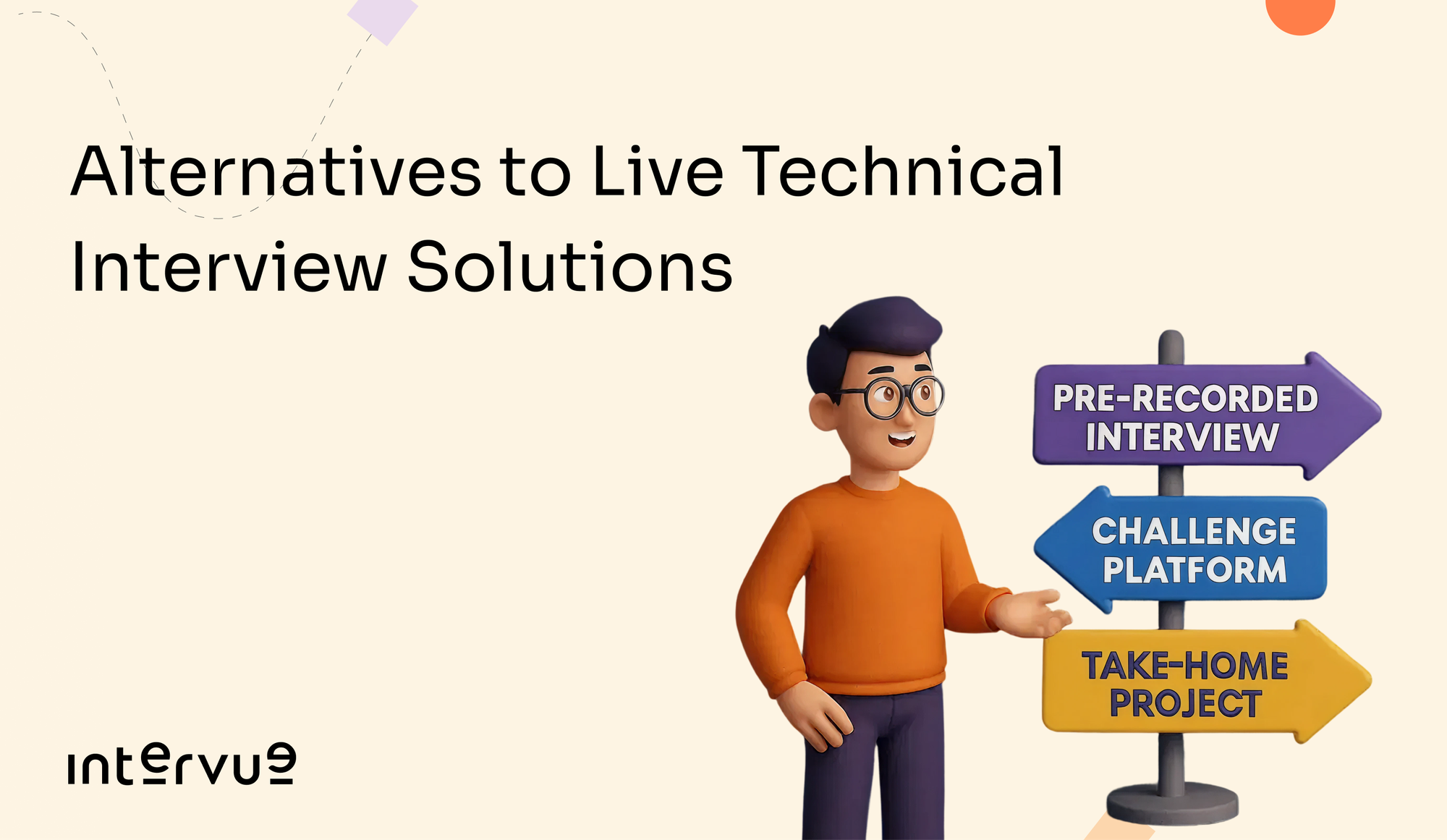
In this guide, we’ll unpack four major categories of alternatives:
- Asynchronous video interview platforms (Spark Hire, HireVue, Hireflix, etc.)
- Automated coding assessment platforms (iMocha, Codility, CodeSignal, Canditech, Shadecoder, LockedIn AI)
- Take-home project and portfolio-based solutions (LeetCode, Codewars, Google Cloud Skills Boost, etc.)
- Mock interview and coaching platforms for candidate preparation
These alternatives particularly benefit:
- Remote and global teams battling time zones
- High-volume engineering hiring (campus, graduate, junior roles)
- Cost-conscious startups needing signal without building a huge interview panel
- Teams embracing structured, data-led hiring over ad-hoc interviews
Throughout, we’ll also note where a hybrid approach — async screening plus a short, structured live round — outperforms either extreme.
What Are Live Technical Interview Solutions?
Live technical interview solutions are platforms designed to facilitate real-time coding and evaluation between a candidate and interviewer. Typical formats include:
- Real-time coding in a collaborative IDE
- Whiteboard-style problem solving over video
- Pair-programming or debugging tasks with an engineer observing
- Live Q&A about system design, architecture, or prior projects
Common tools and ecosystems in this category include HackerRank, LeetCode, CodeSignal, InterviewBuddy, Google Cloud Skills Boost, Shadecoder, and LockedIn AI. Many of these platforms also provide question banks, reporting, and integrations with ATS systems.
Where They Work Well
Live formats are strong when you need to:
- Observe how candidates think out loud
- Assess communication and collaboration skills in real time (Peritus Partners)
- Align on coding style, debugging approach, and trade-off thinking
- Involve multiple stakeholders in a single session (e.g. pair an EM and senior engineer)
Where They Fall Short
However, multiple sources — including developer blogs, candidate surveys, and Reddit threads — point to recurring issues:
- Stress over skill: Studies and practitioner write-ups suggest that being observed while solving a problem can halve performance for some candidates, skewing results towards those who thrive under pressure rather than those who do great work day to day. (WebProNews)
- Scheduling & time zones: Coordinating multiple interviewers and candidates across regions is consistently one of the biggest bottlenecks in tech hiring. (pndtalent.com)
- Inconsistent interviewer quality: Interviewers vary in skill, preparation, and bias — leading to different candidate experiences and signals.
- Poor scalability: Each live interview consumes senior engineering time; this doesn’t scale well for graduate, bootcamp, or re-entry programmes with hundreds of applicants.
- Candidate perception: Articles from platforms like freeCodeCamp, independent bloggers and communities highlight that many candidates see live coding as disconnected from realistic work and overly reliant on memorising patterns. (FreeCodeCamp)
As a result, hiring teams are increasingly turning to async, automated, and project-based alternatives.
Why Companies Are Looking for Alternatives
The shift away from purely live technical interviews is driven by both candidate sentiment and operational realities.
1. High Candidate Drop-Off Under Live Pressure
Critiques of live coding interviews argue that they disproportionately measure stress tolerance rather than true engineering capability. Writers have highlighted research showing that candidates being observed perform significantly worse than those solving the same problems alone. (Mustapha Hadid)
On Reddit and other forums, candidates frequently describe:
- Panic or blanking out in front of a panel
- Feeling judged for “typing speed” rather than design choices
- Opting out of processes that require multiple live coding rounds (Reddit)
This leads to avoidance of certain employers and higher drop-off rates.
2. Time Zone and Scheduling Challenges
For global teams, every live interview is a calendar puzzle. Coordinating:
- Candidate availability
- One or two engineers
- Possibly a hiring manager
…quickly becomes the slowest step in the process. Async video and coding assessments eliminate that bottleneck by allowing both sides to participate in their own time.
3. Inconsistent Interviewer Quality
Even with structured rubrics, live interview quality varies:
- Some interviewers guide and probe; others simply watch and judge
- Feedback can be subjective, poorly documented, or inconsistent
- New interviewers often receive minimal calibration
This inconsistency is what alternative solutions try to solve with standardised tasks, rubrics, and AI-assisted scoring.
4. Poor Scalability for High-Volume Hiring
For cohorts of hundreds or thousands of applicants, live coding simply does not scale:
- It consumes expensive engineering hours
- It delays offers because of scheduling queues
- It makes it hard to compare candidates at the same stage objectively
Platforms like iMocha and CodeSignal explicitly position themselves as scalable skills assessment engines, offering large skills libraries, real-world coding environments, and AI-powered analytics to support high-volume hiring. (iMocha)
5. Shift Toward Async & Real-Work Simulations
Modern engineering work is asynchronous, collaborative, and often AI-assisted. As a result:
- Take-home coding challenges and project-based tasks are gaining popularity; they are seen as more representative and more candidate-friendly. (algocademy.com)
- Simulation-based tools that mirror real IDEs, repos, and tasks are being adopted at enterprise scale. (iMocha)
- AI-driven assessments (e.g. iMocha, Canditech, Shadecoder, Clovers AI) are used to automate scoring, detect cheating, and surface insights.
At the same time, news reports highlight a surge in AI-assisted cheating in traditional interviews, pushing hiring teams to rethink both format and integrity controls. (Business Insider)
Evaluation Criteria for Comparing Alternatives
To compare alternatives to live technical interview solutions, it helps to define transparent criteria:
- Async support
- Can candidates complete tasks without live scheduling?
- Does the platform support one-way video, async code tests, or recorded responses?
- Coding environment realism
- Does it simulate a real IDE, with file systems, tests, and build tools?
- Can you assess workflow — not just final answers?
- AI grading and feedback
- Is there automated scoring for correctness, complexity, and style?
- Does AI assist with proctoring and plagiarism detection?
- Multi-language support
- How many languages and frameworks are supported?
- Are modern stacks covered (e.g. Go, Rust, Node, React, cloud infra)?
- Candidate experience
- Is the UX clear, mobile-friendly, and accessible?
- Are time expectations and evaluation criteria transparent?
- Integration with ATS/HR tools
- Does the platform integrate with your ATS, HRIS, or collaboration tools?
- Can hiring teams review candidates without switching systems?
- Scalability for volume hiring
- Can you deliver hundreds of assessments in a batch?
- Are there APIs and automation for bulk invitations and reminders?
- Real-time analytics and replayability
- Do you have dashboards for funnel conversion and pass rates?
- Can interviewers replay code or video to calibrate decisions?
- Cost and admin overhead
- Licensing, per-candidate pricing, and credits
- Internal time requirements for setup, question design, and review
Using a criteria grid like this helps you compare very different tools — from async video to AI-scored code sims — on a level playing field.
Top Alternatives to Live Technical Interview Solutions
Asynchronous Video Interview Platforms
Examples
- Spark Hire
- Async Interview
- HireVue
- VidCruiter
- myInterview
- Hireflix
- Willo
- Jobma
- Hirevire
- Clovers AI
Asynchronous video tools allow you to pre-record questions and invite candidates to submit video responses on their own schedule. Platforms like Spark Hire specialise in one-way interviews and are widely used to streamline early screening, reduce scheduling friction, and create more consistent first-touch experiences. (Spark Hire | Flexible Hiring Software)
Use cases
- First-round screening for engineering roles
- Behavioural and cultural-fit questions
- Light technical Q&A or explanatory questions (“Talk through a system you recently designed”)
Pros
- Strong scalability for early funnel
- No scheduling friction
- Replayable and shareable with multiple stakeholders
- Often come with structured rating forms and ATS integrations
Cons
- Limited hands-on coding signal
- Some candidates find one-way video less personal or overly automated
- Requires careful question design to avoid bias or irrelevance
Automated Coding Assessment Platforms (Async + AI-Powered)
Examples
- iMocha
- Codility
- HackerRank
- Canditech
- CodeSignal
- Shadecoder
- LockedIn AI
These platforms provide auto-graded coding assessments and often broader skills tests (e.g. SQL, data analysis, cloud skills). Tools like iMocha and CodeSignal emphasise real-world simulation, large skills libraries, and AI-based analytics across languages and roles. (iMocha)
Pros
- Objective scoring and reduced interviewer subjectivity
- Highly scalable for high-volume campaigns
- Rich analytics for benchmarking and skills intelligence (Practice4Me)
- Built-in tools for proctoring and plagiarism detection
Cons
- Can feel impersonal if used as the only signal
- Poorly chosen questions can still feel like “puzzle factories”
- Requires ongoing content curation to keep tests fresh and relevant
Take-Home Project and Portfolio-Based Solutions
Examples / ecosystems
- Google Cloud Skills Boost
- LeetCode
- Codewars
- Exercism
- AlgoExpert
- Interview Warmup (Google)
- Placement preparation resources and bootcamp-style platforms
Take-home projects mimic real engineering work: building features, fixing bugs, or working with a small repo over a few hours. Articles from platforms like AlgoCademy, Indeed, and others highlight growing preference for this model as a more realistic and candidate-friendly format when designed carefully. (algocademy.com)
Pros
- High realism and richer signal on code structure, testing, and documentation
- Candidates can work in their own environment, mitigating live pressure
- Great for senior and staff engineers where architecture and trade-offs matter
Cons
- Longer turnaround times
- Requires more review effort, unless supported by automation
- Risk of overlong, unpaid work if not scoped carefully — a common candidate complaint
Mock Interview and Coaching Platforms
Examples
- InterviewBuddy
- Interview Coder
- interviewing.io
- Meetapro
- Hello Interview
- FinalRound AI
- InterviewVibe
These platforms are primarily used by candidates rather than employers. They offer mock interviews, coaching, and feedback to help individuals perform better in live or technical interviews.
Reviews and bootcamp articles describe them as particularly valuable for candidates transitioning careers or targeting big-tech roles, providing access to experienced interviewers and structured feedback loops. (Lambros Petrou personal website)
Pros
- Improve candidate preparedness and confidence
- Provide realistic practice for system design and live coding
- Useful for internal mobility or upskilling programmes
Cons
- Not an automated screening solution for employers
- Signal quality depends on coach calibre
- May widen the gap between coached and uncoached candidates
Collaboration & Workflow Tools as Lightweight Alternatives
Examples
- Trello
- Loom
- Notion
- Slack
- Zapier
Many teams assemble lightweight, low-code workflows using existing collaboration tools:
- Candidates record Loom walkthroughs of take-home projects
- Tasks and status are tracked in Trello or Notion
- Feedback and async discussion happen in Slack
- Integrations and notifications are automated through Zapier
Pros
- Extremely flexible and stack-friendly
- Low incremental cost
- Easy to tailor for unique workflows (e.g. open-source contribution reviews)
Cons
- Requires manual review of artefacts
- Harder to maintain standardised scoring and compliance
- No native proctoring or cheating detection
How to Choose the Right Alternative
When picking alternatives to live technical interview solutions, start with your hiring context:
High-Volume Engineering Roles
For graduate programmes or large recruitment drives:
- Prioritise automated coding assessment platforms like iMocha, CodeSignal, Codility, Canditech, Shadecoder, or LockedIn AI.
- Look for AI-powered scoring, strong proctoring, and bulk operations to manage volume. (iMocha)
Remote and Global Teams
When your pipeline spans many time zones:
- Use async video interviews (Spark Hire, Hireflix, Willo, Jobma, Hirevire, Clovers AI) for initial screens. (Spark Hire | Flexible Hiring Software)
- Combine with async coding assessments to reduce live scheduling to only the final decision round.
Senior and Staff Engineers
For senior roles, breadth and depth matter more than syntax:
- Prefer take-home projects, GitHub portfolio reviews, or simulation-based tasks (e.g. Google Cloud Skills Boost labs).
- Use async tools plus collaborative review in Notion/Slack to focus on design quality, trade-offs, and leadership.
Startups and Scale-Ups
With limited interviewer bandwidth and evolving requirements:
- Adopt a hybrid approach:
- Short async assessment (video + code) for screening
- A compact, structured live round focused on real work (e.g. extending an existing code sample)
- Leverage flexible tools and workflows rather than heavy enterprise suites.
Teams Wanting AI Scoring and Decision Intelligence
If the goal is data-driven hiring:
- Prioritise platforms like Shadecoder, Canditech, iMocha, CodeSignal that offer robust AI scoring, analytics, and replay features. (iMocha)
- Combine these with your ATS and BI tools to track pass rates, score distributions, and predictive validity over time.
FAQs
1.Are live coding interviews becoming outdated?
Live coding isn’t disappearing, but it is no longer the default for every stage or role. Many organisations now use live sessions only after async screening, or replace them with take-home projects and simulations for senior roles to improve realism and candidate experience. (DistantJob - Remote Recruitment Agency)
2.What tools can replace live technical interviews?
You can replace or supplement live interviews with:
- Async video platforms (Spark Hire, HireVue, Hireflix, Willo)
- Automated coding assessments (iMocha, CodeSignal, Codility, Canditech, Shadecoder, LockedIn AI)
- Project-based tasks and labs (Google Cloud Skills Boost, take-home assignments, portfolio reviews)
- Mock interview and coaching platforms (InterviewBuddy, Interviewing.io, Interview Coder)
The right mix depends on volume, seniority, and tech stack.
3.Do asynchronous interviews give reliable technical signals?
They can, provided you:
- Use job-relevant tasks in realistic environments
- Apply structured rubrics and calibration
- Combine async video with coding assessments or projects
Research on skills-based assessments suggests that structured tests and take-home assignments can provide more consistent signals than ad-hoc live interviews, especially for high-volume hiring. (CodeSignal)
4.How do tools like Spark Hire or Hireflix differ from HackerRank?
- Spark Hire / Hireflix focus on one-way video interviews: candidates record answers, and hiring teams review them asynchronously. (Spark Hire | Flexible Hiring Software)
- HackerRank / CodeSignal / iMocha focus on coding assessments and simulations, providing auto-graded tasks and analytics. (iMocha)
Many teams combine both: video for behavioural and communication signal, coding platforms for technical depth.
5.Are AI-scored assessments accurate?
AI-scored assessments are increasingly sophisticated, using test cases, static analysis, code quality metrics, and behavioural signals to score performance. Platforms like iMocha and CodeSignal promote AI-driven fairness, proctoring, and skills intelligence to reduce bias and improve reliability. (iMocha)
Accuracy still depends heavily on:
- Good content design
- Strong validation and benchmarking against real performance
- Transparent use of scores as one input among several, not a single gatekeeper
6.What do candidates prefer more — live coding or async?
Survey data and commentary suggest many candidates prefer take-home challenges and structured async assessments over high-pressure live coding. (DistantJob - Remote Recruitment Agency)
However, preferences vary. A good practice is to:
- Keep live rounds short and focused
- Offer clear instructions and expectations
- Avoid multi-hour unpaid work for take-homes
7.Which tools are best for startup engineering teams?
Startups often benefit from a lean, hybrid stack:
- Async video (e.g. Spark Hire, Willo, Hirevire) for quick screens
- A smaller coding assessment tool (e.g. iMocha, CodeSignal, Canditech) for objective technical signal
- Light workflow tooling (Notion, Slack, Loom) to review portfolios and projects
This keeps cost and complexity low while still giving structured signal.
Where Intervue.io Fits
Intervue.io sits slightly differently to many of the tools above: it is designed to support both live and async technical interviews in a structured, data-driven way.
In a typical stack, teams might use:
- An automated coding assessment (e.g. iMocha or CodeSignal) for high-volume screening
- Intervue.io to host structured live or async technical interviews, with shared coding environments, consistent rubrics, and interview templates
- Collaboration tools and ATS integrations for downstream decisions
Key ways Intervue.io can complement the alternatives discussed:
- Live + async flexibility: Run real-time interviews for final rounds, but also support recorded or time-boxed sessions when scheduling is hard.
- Structured evaluation: Use scorecards, competencies, and replayable sessions to reduce subjectivity and interviewer drift.
- Scheduling reduction: Integrations and automation reduce manual calendar work, especially when combined with async components.
- Interoperability: Intervue.io can sit alongside coding assessment platforms and video tools, acting as the hub for structured, decision-focused conversations with shortlisted candidates.
This positions Intervue.io not as a replacement for every tool, but as a category-defining platform for structured technical interviews that fits neatly into a modern, multi-tool hiring ecosystem.
Final Takeaways
- Live interviews offer rich collaboration but don’t scale well and can overweight stress tolerance.
- Async tools — from one-way video to automated coding assessments — reduce scheduling friction and improve candidate experience.
- AI-driven assessments are becoming standard for volume hiring, offering objective scoring, proctoring, and analytics.
- There are multiple strong alternatives: video-based, coding-based, simulation-based, portfolio-based, and coaching-focused.
- The best approach is usually hybrid: async filtering plus a short, structured final live round.
- Teams should choose tools based on hiring volume, role seniority, tech stack, and global distribution rather than defaulting to one format.
- Platforms like Intervue.io help orchestrate this mix, providing structured, data-led interviews that work alongside assessments and async workflows.