Introduction
AI has officially crossed the experimentation phase in hiring, especially when it comes to AI interviews and early-stage screening.
By 2025, most mid-to-large tech organizations, ranging from global enterprises to Indian unicorns, will be incorporating AI into their interview processes. This shift reflects broader AI hiring trends 2025, where automation is no longer optional but expected. Resume screening, coding assessments, video interviews, and score normalization. Is the question no longer whether we should use AI?
The real question is:Why are some teams hiring better with AI, while others are quietly losing confidence in their decisions?
The answer, backed by hiring data across regions and roles, is simple and uncomfortable: AI doesn’t improve interviews by default. It amplifies whatever interview system you already have.
At Intervue, after analyzing interview outcomes alongside global AI-hiring research (McKinsey, SHRM, IEEE, and peer-reviewed interview studies from 2024–2025), one pattern stands out clearly: AI is a force multiplier, not a replacement engine.
Why AI interviewers still depend on strong human-led interview design
One of the most persistent myths in hiring today is that AI will “replace interviewers.” In reality, AI is doing something far more consequential: it’s magnifying the strengths and weaknesses of interview design.
In structured environments, where questions, rubrics, and expectations are clearly defined; AI performs exceptionally well. Multiple large-scale studies show that AI interview scoring aligns with expert human evaluators up to 91% of the time in structured coding and behavioral interviews (IEEE Software, 2024; Journal of Applied Psychology, 2023).
However, the same research shows a steep drop in reliability when interviews rely on unstructured conversation or intuition-heavy evaluation.
Automated Video Interview (AVI) research published in 2024 found that AI could explain about 44% of the variance in human performance ratings. That’s a meaningful contribution but it also highlights a hard limit. More than half of what determines hiring trends still comes from human judgment: probing, contextual understanding, and interpretation of trade-offs.
For fast-scaling companies, this distinction is critical.
Indian startups like Zepto, Swiggy, Zomato, Razorpay, Zerodha, and OYO operate in hiring environments defined by volume, speed, and uneven interviewer experience. In these environments, interviews with AI are often the first layer — but never the final decision-maker. In these conditions, AI layered on top of a weak interview structure doesn’t create fairness — it creates confident inconsistency. Strong structure plus AI, on the other hand, produces clarity at scale.
Key insight for enterprise teams:AI is not an equalizer. It is a multiplier.Strong interview systems + AI = better signal.Weak systems + AI = faster noise.
The new interview productivity divide
Most leaders adopt AI for speed and they’re not wrong.
Global hiring surveys show that 68% of companies using AI report a 30–50% reduction in early-stage screening time (SHRM Talent Trends, 2024). Over half also report improved scoring consistency across interviewers, especially in coding and behavioral rounds.
But productivity gains are not evenly distributed.
The same datasets reveal that 59% of hiring leaders believe AI interviews and assessments miss key skills, particularly debugging, architectural reasoning, and problem decomposition, skills that matter most after the offer is accepted.
This divide is especially visible in India’s tech ecosystem.
High-volume D2C and logistics startups benefit immediately from AI-powered pre-screens. But engineering-led organizations, Zerodha is a classic examples, have learned that speed without signal degrades hiring quality over time.
Across Intervue’s data and external benchmarks, one conclusion repeats consistently:A trained human interviewer using AI support produces 2–3× more actionable signal than AI operating alone.
That signal comes from better follow-up questions, structured evaluation, and consistent calibration not from automation replacing judgment.
Interview demand is rising, not shrinking
Despite automation narratives, interviews are not going away.
According to LinkedIn Workforce and Gartner hiring trends outlook data, 72% of companies expect interview volume to remain steady or increase over the next three years. Even more telling, 83% of hiring managers say final hiring decisions still rely primarily on human-led interviews.
Indian enterprises mirror this trend.
Companies like OYO, which hire across geographies and functions, rely on interviews to assess ambiguity handling, ownership, and decision-making, competencies that cannot be reliably inferred from automated scores alone.
Where AI delivers real ROI today is in interviewer enablement, not interviewer elimination. Enterprise teams are prioritizing AI-enhanced rubrics, interviewer upskilling, and removing low-signal take-home tests that slow hiring without improving outcomes.
The consensus is clear: AI should accelerate decision-making, not outsource it.
Why hiring confidence is eroding in the AI era
Here’s the paradox many enterprise leaders are experiencing: as AI tools become more powerful, confidence in hiring decisions is dropping.
Between 2024 and 2025, the percentage of leaders who said assessing real skills is difficult jumped from 19% to 34% (Gartner Hiring Pulse, 2025). Overall confidence in hiring accuracy dropped from 67% to 49%. Nearly 71% of leaders now say AI makes it harder to evaluate technical skills accurately.
This isn’t because candidates are “cheating.” It’s because AI changes how candidates communicate.
AI-assisted answers are polished, fluent, and structurally sound. Code compiles. Explanations sound confident. But depth is often obscured especially in system design, debugging, and architectural reasoning.
The real issue is loss of visibility into thinking. Without structured probing and clear evaluation frameworks, teams mistake articulation for competence.
Where AI works and where it consistently fails
Across industries and roles, AI performance follows a predictable pattern.
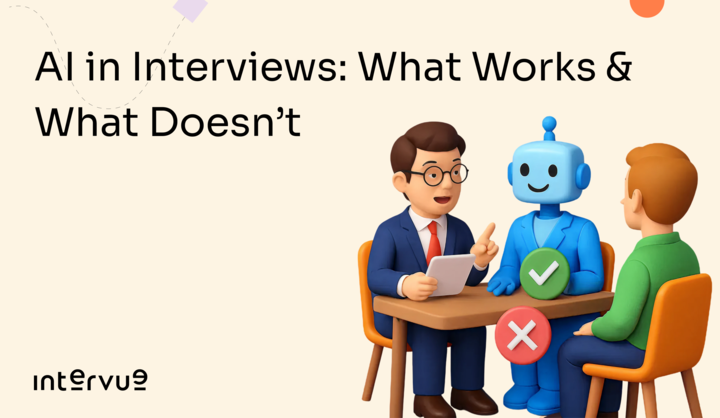
AI excels in structured signal extraction: high-volume coding screens, standardized behavioral questions, score normalization, interview note summarization, and consistency audits. These are areas where scale and repeatability matter most.
Where AI underperforms is equally consistent: system design interviews, live debugging, leadership evaluation, and innovation or potential assessment. These require context, trade-off reasoning, and dynamic questioning, areas where human judgment remains irreplaceable.
This mirrors findings from global AI-readiness studies: AI is strong at pattern recognition in structured data, but weak in context-heavy reasoning environments.
Human + AI interviews outperform every other model
When AI supports rather than replaces human interviewers, outcomes improve measurably.
Hybrid interview models show a 33% improvement in signal clarity compared to human-only processes (Intervue platform analysis, 2025). AI interviews perform 22% worse at identifying debugging ability, while take-home projects show weaker correlation with on-the-job performance than live, AI interviews.
Looking ahead, enterprise teams expect shorter time-to-offer, fewer early-stage mis-hires, and a clear shift away from static tests toward AI-supported live interviews.
The best-performing model is no longer human vs AI. It is human judgment multiplied by AI consistency.
Global adoption and why India is pulling ahead
AI-assisted interviewing adoption varies sharply by region.
India and China have adopted AI in interviews at scale faster than the U.S., and report higher confidence in workforce AI readiness. Investment patterns differ as well: Chinese and Indian companies are more likely to invest in human + AI capability building, while U.S. firms skew toward cost-cutting automation.
For Indian enterprises and startups, this represents a strategic advantage. Teams that build structured, AI-supported interview systems today are creating hiring engines that scale globally without eroding quality.
The enterprise takeaway
Across every dataset and geography, one conclusion is consistent.
AI improves consistency and removes noise. Humans provide context, depth, and judgment. Candidates trust hybrid interviews more than AI-only systems. Enterprises get faster, fairer, higher-signal hiring decisions.
The future of interviewing is not human or AI. It’s the two working together.
At intervue.io, this is the model we’re building toward: expert interviewers supported by structured AI signal extraction, bias monitoring, and real-time evaluator support, designed specifically for teams hiring at scale.
Not replacing human judgment.Strengthening it, where it matters most.