
TestGorilla is one of the most widely adopted pre-employment assessment platforms, 350+ skills tests, AI resume scoring, structured assessments across technical and non-technical roles. For HR-led screening across multiple functions, it built a real following.
But the reviews tell a more complicated story. Candidates burning out on 9-minute sprints. Engineers calling it the wrong tool for technical hiring. Small businesses trapped in annual contracts they can't exit. And a rigid scoring system that filters out unconventional candidates automatically, including strong ones.
Here's what's actually driving the search for TestGorilla alternatives, and what the switch looks like.
Why Are Hiring Teams Looking for TestGorilla Alternatives?
The time limits are filtering for reading speed, not ability. TestGorilla stacks multiple micro-tests together with aggressive time limits. Candidates report being given 12-16 complex situational questions with 9 minutes to complete the entire section. When a question takes 20–30 seconds just to read, the test stops measuring job competence and starts measuring who can skim fastest under pressure. That's not a hiring signal, that's a stress test.
Technical depth isn't there for engineering roles. TestGorilla offers 350+ tests and covers coding, but its technical assessments are largely multiple-choice or isolated code snippets. There's no multi-file IDE simulation, no real development environment, and no way to evaluate how an engineer actually works. For companies hiring mid-to-senior engineers, this is a fundamental gap.
The annual contract trap catches teams off guard. TestGorilla advertises monthly ratesCore at ~$135/month, but all paid plans require a 12-month commitment billed upfront. There's no monthly option. Teams that complete a hiring surge and don't need the platform for six months are still paying for it. And credits don't roll over between billing periods. G2 reviewers describe it as "burning money on empty seats."
Rigid scoring penalises unconventional candidates. TestGorilla's automated ranking algorithm can quietly filter out non-traditional thinkers, candidates who stumble on cognitive or personality tests but would excel in the actual role. Recruiters only see the ranked output. They don't always know who got filtered before the shortlist was generated.
Customer support doesn't match the price. Multiple verified reviews on G2 and Capterra document teams trapped in annual contracts they couldn't cancel, refund requests denied on policy grounds, and support that cycles through automated responses. For a platform at this price point, that's a problem.
TestGorilla vs Intervue: The Assessment Comparison
Question Integrity and Depth
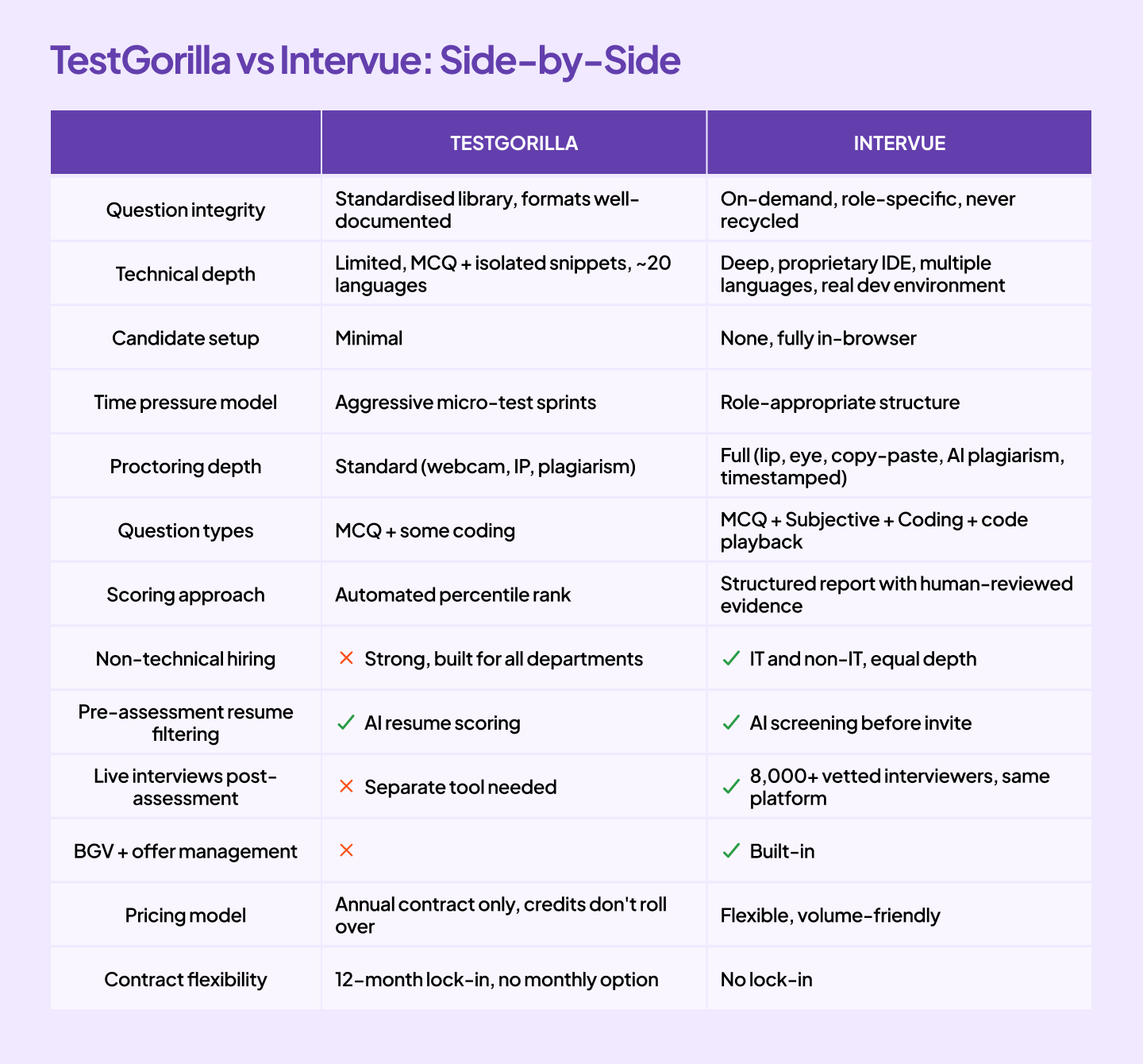
TestGorilla pulls from a standardised library of 350+ tests. The library is broad enough for HR-led screening across common roles, but for technical hiring the depth is limited, primarily MCQs and isolated code snippets, with limited language coverage for specialised stacks. The library is also well-known, which means candidates who have done their research can anticipate question formats.
Intervue generates questions on demand, per role, at the time of assessment, objective, subjective, and coding.
They don't exist anywhere online before the candidate sees them. For technical roles, Intervue's proprietary coding environment supports multiple programming languages in a real development context, not isolated snippets. For non-technical roles, subjective questions surface reasoning and judgment that MCQs can't capture.
Candidate Experience and Time Pressure
TestGorilla is built around stacked micro-tests with rigid time limits. The intent is efficiency. The outcome, based on consistent candidate feedback, is that the format filters for rapid comprehension under stress rather than actual role competence. Strong candidates, particularly experienced professionals evaluating multiple offers, find the format frustrating enough to abandon.
Intervue runs entirely in-browser with zero setup required. No configuration, no extensions to disable, no desktop app. Candidates open the link and start. The assessment is structured around the role, not a standardised time-pressure sprint, which means completion rates go up and the signal you get actually reflects ability.
Proctoring and Assessment Integrity
TestGorilla covers standard anti-cheating measures, webcam monitoring, IP tracking, and plagiarism detection. Adequate for most general screening use cases.
Intervue goes deeper, tab switches, copy-paste detection, lip movement, eye tracking, and AI-powered plagiarism detection. Every signal is timestamped and surfaced in the candidate report for a human to review. You're not getting a flag; you're getting evidence to make an informed call.
Scoring and Reporting
TestGorilla delivers automated, percentile-ranked scores. The system works well when you're screening at volume for standardised roles. The risk: the algorithm ranks candidates without context, and unconventional thinkers who score low on cognitive or personality tests can be filtered out before a human ever sees them.
Intervue delivers structured reports with per-candidate breakdowns, proctoring evidence, subjective answer visibility, and actual code submitted for technical roles. Hiring managers see the reasoning, not just the rank. The decision stays with the human.
Technical Hiring Depth
TestGorilla was built for broad, HR-led screening across all departments. Its coding coverage is limited, roughly 12 coding tests across 20 programming languages publicly listed. For companies hiring mid-to-senior engineers with specialised stacks, this falls short.
Intervue was built with technical hiring as a core use case. The coding environment is proprietary, supports multiple languages, and mirrors a real development environment. Coding, subjective, and objective questions can all sit in the same assessment. And when a candidate clears the assessment and needs a live technical round, Intervue's 8,000+ vetted interviewer panel, engineers from Tier I companies, conducts it on the same platform.
TestGorilla vs Intervue: Side-by-Side
And Then There's Everything TestGorilla Doesn't Do
Once the assessment is done, TestGorilla hands you a ranked list and steps back. Live interviews, internal rounds, BGV, offer management, all in different tools, with context that resets at every handoff.
Intervue doesn't stop at the assessment. When a strong candidate needs a live technical round, an interviewer from Intervue's 8,000+ vetted panel picks up exactly where the assessment ended, same rubric, same context, no reset. Before the assessment goes out, AI resume screening filters applicants so your assessment pool arrives pre-qualified. Internal interviews, BGV, and offer letters all run on the same platform.
One workflow. From application to offer.
Where TestGorilla Still Works
To be fair, TestGorilla earns its place in specific contexts.
Broad, HR-led screening across multiple departments: For companies hiring across Sales, Marketing, Finance, and Operations using standardised tests, TestGorilla's library breadth is genuinely useful and easy to deploy quickly.
Cognitive and personality assessment at scale: The platform's scientifically validated cognitive ability and personality tests are well-regarded for volume screening of non-technical roles.
ATS integrations: Connects cleanly with Greenhouse, Lever, BambooHR, Workday, and others, plugging into most enterprise recruiting stacks without custom work.
If your hiring is primarily non-technical, volume-based, and you have the budget for an annual commitment, TestGorilla is a reasonable fit. But if you're hiring engineers, need assessment flexibility without a lock-in, or want the full hiring loop in one platform, it's time to look elsewhere.
How Much Does TestGorilla Cost?
Free plan: 5 skills tests from the library, AI resume scoring, 1 recruiter seat. Enough to test the product, not enough to run a real hiring process.
Core: ~$1,700/year (~$135/month): 350+ tests, 400 credits, 2 premium seats, AI scoring, sourcing features. Annual commitment only. No monthly option.
Plus, custom pricing: Video interviews, ATS integrations, API access, coding challenges, custom test building. No published price, requires a sales conversation.
What the pricing page doesn't say: Credits don't roll over. Annual commitment is required upfront. If hiring slows mid-year, you continue paying. Multiple G2 and Capterra reviewers describe being locked into contracts they couldn't exit, with refund requests denied on policy grounds.
Intervue's pricing is flexible and volume-friendly, you pay for what you actually use, with no annual lock-in and no credit expiry.
See what the switch looks like for your team.
Trusted by Razorpay, NPCI, Rakuten, British Petroleum, and 500+ hiring teams globally.
FAQs
What is the best TestGorilla alternative? For broad skills screening with similar coverage, iMocha and Vervoe are the closest alternatives. For a platform that goes deeper on technical assessments, eliminates lock-in pricing, and connects assessment to live interviews and offer management in one workflow, Intervue is the only full-funnel option in this category.
Is TestGorilla good for technical hiring? TestGorilla covers coding, but its technical depth is limited, primarily MCQs and isolated snippets across roughly 20 programming languages. For mid-to-senior engineering roles or specialised stacks, the signal is thin. Intervue's proprietary coding environment and 8,000+ technical interviewer panel are built specifically for engineering hiring depth.
Why are candidates dropping off TestGorilla assessments? The time-pressure model, aggressive limits on stacked micro-tests, is the most consistent complaint from candidates. The format filters for rapid comprehension under stress rather than job competence. Intervue structures assessments around the role, not a standardised sprint format.
Is TestGorilla's annual contract worth it? For companies with consistent, high-volume hiring across non-technical roles, the annual commitment can be cost-effective. For teams with uneven hiring cycles or companies primarily hiring engineers, the lock-in creates risk, unused credits expire, and exit options are limited. Intervue's flexible pricing adjusts to how you actually hire.