Here's something most candidates don't realise until it's too late: you can solve a problem correctly and still fail the round.
FAANG interviews don't just evaluate whether your code works. They evaluate whether you can think through a problem systematically and communicate that thinking clearly to another person, in real time, under pressure, with a clock running.
Thinking out loud isn't a bonus skill. It's the skill. And for most candidates, it's the one they've never practiced.
This guide covers exactly what thinking out loud looks like in a coding interview, what to say at each stage, the most common silence traps candidates fall into, and how to build this skill before your actual loop.
TL;DR: What Thinking Out Loud Actually Means
Thinking out loud in a coding interview means narrating your reasoning at every stage, before you code, while you code, and after you code. It doesn't mean talking constantly. It means never going silent in a way that leaves the interviewer with no visibility into your thought process.
The interviewer's job is to evaluate your thinking, not guess at it.
Why Thinking Out Loud Is Harder Than It Sounds
Most engineers have spent years solving problems alone. The feedback loop is: read problem → think → type solution → run tests → done. Internal, sequential, silent.
A coding interview inverts this. The thinking has to be externalised and communicated simultaneously with the doing. That requires a separate cognitive layer that most candidates have never trained.
The result: a candidate who knows the answer goes quiet for four minutes while they think, writes code in silence, and then explains it only when asked. From the interviewer's perspective, that session is nearly unreadable, even if the code at the end is correct.
What they needed to see was the thinking, the approach choices, the edge case awareness, the tradeoff reasoning, all the signals that distinguish a strong hire from someone who happened to have seen this problem before.
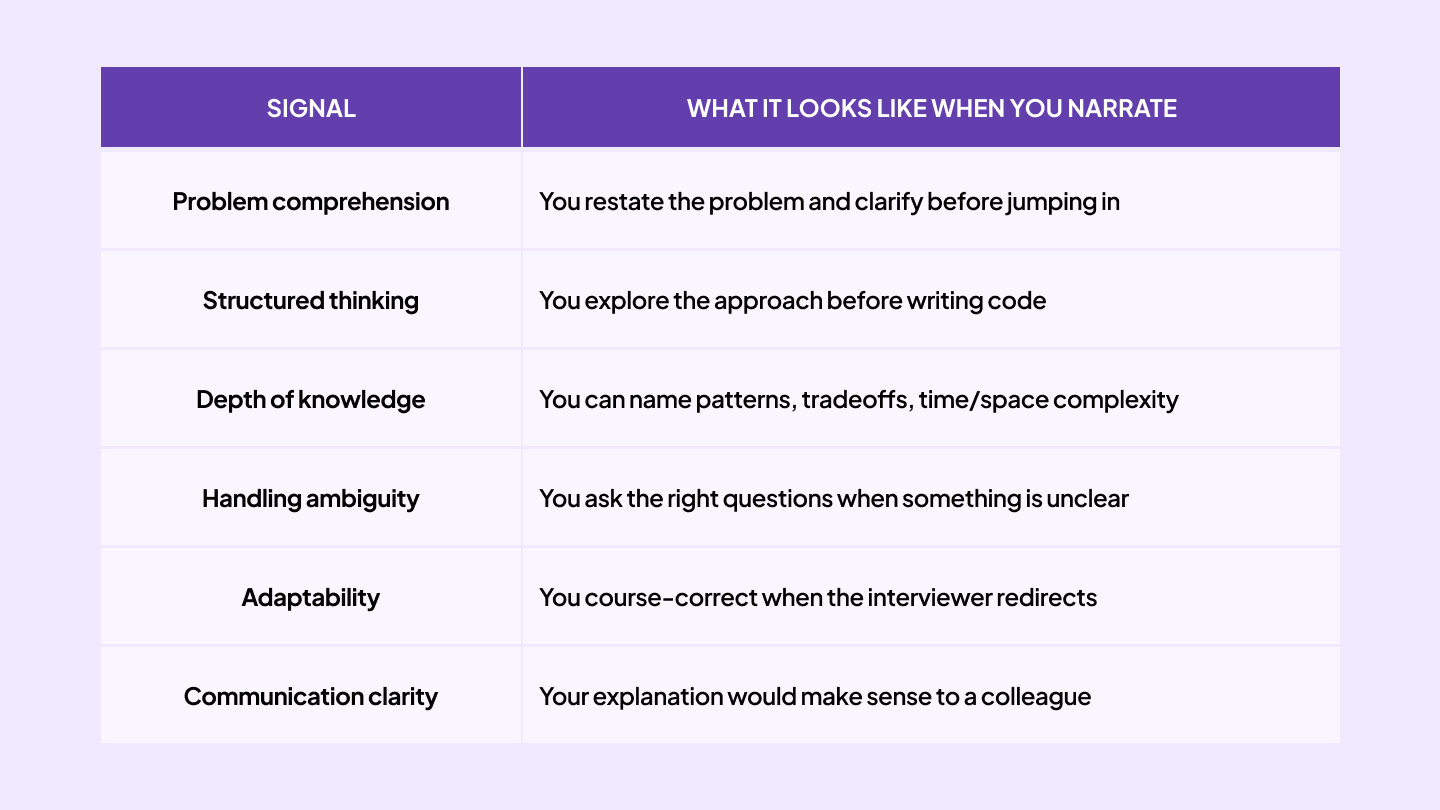
What Interviewers Are Evaluating When You Think Out Loud
Understanding the rubric changes how you prepare.
The 5 Stages of a Coding Interview, And What to Say at Each One
Stage 1: When You First Receive the Problem (2–3 minutes)
This is the stage where most candidates make their first mistake: they start coding.
Don't. Read the problem fully. Then narrate your understanding back before doing anything else.
What to say:
- "So if I understand correctly, we're given X and we need to return Y, is that right?"
- "A few clarifying questions: can the input be empty? Can we have duplicate values? Is the input sorted?"
- "What's the expected input size? I want to know whether we need an O(n log n) solution or if O(n²) is acceptable."
Interviewers don't penalise you for asking clarifying questions. They penalise you for not asking them and then building a solution that doesn't handle edge cases.
Stage 2: Exploring the Approach (3–5 minutes)
Before writing a single line of code, talk through how you're thinking about the solution.
What to say:
- "My first instinct is a brute-force approach, for each element, check all others. That's O(n²) time and O(1) space. But I think we can do better."
- "This looks like a sliding window problem to me, we have a constraint on the subarray size and we want to optimise something within it."
- "I'm going to try a two-pointer approach. Let me walk through why I think that works here..."
- "One edge case I'm already thinking about: what happens if all elements are negative? Let me make sure my approach handles that."
Naming the pattern you're applying is not showing off, it's giving the interviewer a frame of reference for what you're about to do.
Stage 3: While You're Coding (ongoing)
This is where candidates most often go silent, and where the silence does the most damage.
You don't need to narrate every keystroke. But you should narrate decisions as you make them.
What to say while coding:
- "I'm using a hash map here to store the frequencies, this gives us O(1) lookup instead of O(n) scanning."
- "I'll initialise the left pointer at zero and move the right pointer until the window exceeds our constraint."
- "This variable tracks the running maximum, I'll update it at each step."
- "I'm handling the empty input case first, returning early rather than letting it propagate."
If you make a mistake and catch it: "Wait, that's wrong. If I do it that way, I'd be modifying the input. Let me use a copy instead."
Catching your own mistakes out loud is a positive signal. It shows self-awareness and debugging skill.
Stage 4: When You're Stuck (the hardest part)
Going silent when you're stuck is the single most damaging thing you can do in a coding interview. The interviewer can't help you if they don't know where you are.
What to say when you don't know the answer:
- "I know what output I need but I'm not sure of the most efficient way to get there, let me think about what data structure would make the lookup faster..."
- "I'm trying to figure out the right recurrence here. The answer at position i should depend on... let me work through a small example."
- "I have a brute-force approach that works but it's O(n²). I'm trying to think about whether I can use a sorted structure or a hash map to bring that down."
Narrating your uncertainty is not weakness. It's the signal that you know how to keep making progress even when you don't have an immediate answer, which is exactly what the job requires.
If you're genuinely stuck and silent narration isn't moving you forward: "I think I need a hint here, can you tell me whether I'm heading in the right direction with the hash map approach?"
Asking for a hint is far better than silence.
Stage 5: After You've Written the Code
When you finish coding, don't hand it over silently. Walk through it.
What to say:
- "Let me trace through this with a quick example to make sure it works."
- "The time complexity is O(n) because we visit each element at most twice. Space is O(n) for the hash map."
- "Edge cases I handled: empty input returns early, duplicates are handled by the hash map update, and the minimum case of a single element is covered by the base case at line 3."
- "One thing I'd improve in production: I'd add input validation at the top and extract the core logic into a helper function for testability."
That last comment, what you'd do differently in production, is the kind of thing that turns a "hire" into a "strong hire."
The 4 Silence Traps to Avoid
Silence Trap 1: Thinking before speaking Many engineers need to think before they can speak. In interviews, this creates long pauses that look like uncertainty. Fix: narrate your thinking as you're doing it, even if it's incomplete. "I'm considering two approaches..." is better than two minutes of silence followed by "so I decided to use a hash map."
Silence Trap 2: Coding in focus mode The same deep focus that makes you a good engineer works against you in interviews. Set a habit: after every 3–5 lines of code, pause and say one sentence about what you just did and why.
Silence Trap 3: Getting stuck and shutting down The instinct when stuck is to go internal and think harder. In an interview, this reads as disengagement. The fix is already covered above, narrate uncertainty instead of suppressing it.
Silence Trap 4: Skipping the walkthrough at the end Finishing and handing over code without a trace-through is a missed opportunity to show correctness, edge case handling, and complexity awareness. Never skip it.
How to Build This Skill Before Your Interview
The only way to build this skill is to practice it out loud, not in your head, not on paper, out loud.
Practice method 1: Record yourself Set a timer for 30 minutes, pick a medium LeetCode problem you haven't solved before, and record yourself solving it while narrating out loud. Watch the recording. You will be uncomfortable. That discomfort is the gap between how you think you sound and how you actually sound in an interview.
Practice method 2: Peer practice Solve problems with a friend or peer and take turns as interviewer and candidate. The interviewer's job is only to watch and give feedback at the end. No helping during the solve.
Practice method 3: Expert mock interviews This is the most efficient approach. A real interviewer who has evaluated candidates before can tell you not just that you went silent, but exactly when, why it mattered, and what you should have said instead.
At Intervue.io, every mock coding session includes structured feedback on communication quality, not just whether your solution was correct. You'll know if you're narrating enough, if your explanations are clear, and whether your approach to handling ambiguity reads as confident or uncertain to the person on the other side.
This is the kind of feedback that fundamentally changes how you perform in real interviews.
👉 Practice thinking out loud in a mock session on Intervue.io
A Before and After Example
The same candidate solving the same problem, two different performances: Without thinking out loud:
[Reads the problem. Silent for 3 minutes. Types code. Finishes.]
"Here's my solution. It uses a hash map."
[Interviewer: "Can you walk me through it?" ]
"Oh yeah, so I iterate through the array and store the complement in the map..."
With thinking out loud:
"Okay, so we're given an array of integers and a target, we need to return the indices of the two numbers that add up to the target. Can I assume there's exactly one solution? And can the same element be used twice? Great.
My first thought is brute force, check every pair, O(n²). But since we're looking for a complement, we can use a hash map. As we iterate, we store each number's index. For each new number, we check if its complement already exists in the map. If it does, we've found our pair. That brings us to O(n) time and O(n) space.
Let me code that up...
I'm initialising an empty hash map. For each index i, I compute complement = target - nums[i]. If complement is already in the map, I return [map[complement], i]. Otherwise, I store nums[i] → i and move on.
Let me trace through the example: [2, 7, 11, 15], target 9. At index 0, complement is 7, not in map yet. Store 2 → 0. At index 1, complement is 2, found! Return [0, 1]. Correct.
Time complexity O(n), space O(n). Edge cases: the problem guarantees exactly one solution, so I don't need to handle the no-solution case. If that changed, I'd return an empty array at the end."
The second candidate said exactly what they were doing at every step. The first made the interviewer guess. In a close decision, the second candidate gets the offer. In an easy decision, only the second candidate is in contention.
👉 Practice thinking out loud in a mock session on Intervue.io
FAQs
What if thinking out loud slows me down too much? Initially it will. That's normal, you're running two processes simultaneously that you've only ever run separately. With 5–10 hours of deliberate practice, the narration becomes natural and stops competing with your thinking. The candidates who don't practice this take the full interview round to discover the adjustment.
Should I narrate every single line of code? No. Narrate decisions, why you chose a data structure, what a variable represents, what an edge case you're handling is. You don't need to say "I'm opening a for loop", you need to say "I'm iterating through the array to..." The decision is what the interviewer needs, not the syntax.
What if I'm wrong about my approach and I've already said it out loud? Say that out loud too: "Actually, I think that approach has a problem, if the input has duplicates, my hash map would overwrite earlier indices. Let me adjust to store a list of indices instead." Catching and correcting your own mistakes in real time is a strong positive signal.
How do I handle the pressure of someone watching while I code? The pressure is real, and there's no shortcut around it, only through it. The candidates who manage it well are the ones who've experienced it before, in mock sessions. By the time you've done 5 mock interviews with a real person watching, the social pressure in a real interview feels like something you've already handled.
Is thinking out loud different for system design vs. coding rounds? The principle is the same, but system design rounds involve more back-and-forth discussion from the start. In coding rounds, you're doing more narrating. In system design, you're more often explaining a decision and then waiting for a probe. Both require continuous communication, just at different rhythms.