

Amazon's behavioral interviews are unlike any other company's. Most companies ask behavioral questions as part of the loop. Amazon has built an entire evaluation system around them, 16 explicit Leadership Principles that interviewers reference by name, a Bar Raiser who evaluates your fit independently, and a hiring committee that reads your LP signal across every round.
If you walk into an Amazon interview without understanding how this system works, you will underperform, regardless of your technical ability.
This guide covers all 16 Amazon Leadership Principles, what interviewers are actually scoring, how to build stories that pass the bar, and the most common mistakes that eliminate qualified candidates.
TL;DR - What You Need to Pass Amazon's LP Rounds
- Understand all 16 Leadership Principles and what each actually means in practice
- Prepare 8-10 strong STAR stories, each mappable to multiple LPs
- Use "I" not "we", interviewers are evaluating your individual contribution
- Quantify outcomes wherever possible, Amazon is data-driven by design
- Know the Bar Raiser's role and prepare for follow-up questions that go 3–4 levels deep
What Are the Amazon Leadership Principles?
The Amazon Leadership Principles (LPs) are 16 values that define how Amazon expects its employees to think, make decisions, and operate, at every level, from intern to VP.
They are not soft skills talking points. They are explicit evaluation criteria. Every Amazon interviewer is assigned specific LPs to probe in their round and submits feedback mapped to those principles after your interview.
The hiring committee doesn't just ask "did this candidate perform well?" It asks "does this candidate demonstrate the Leadership Principles we need at this level?"
All 16 Amazon Leadership Principles Explained
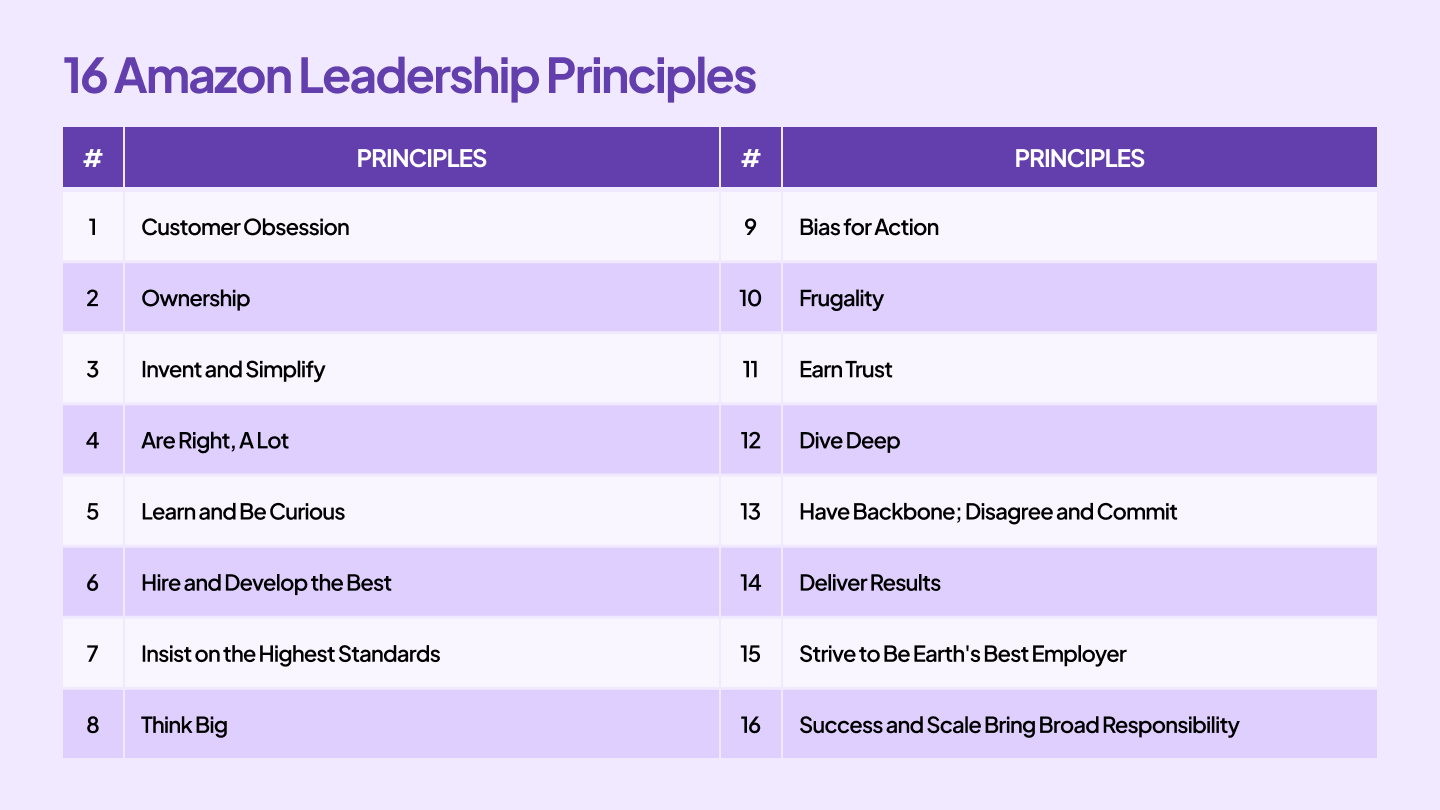
1. Customer Obsession
Leaders start with the customer and work backwards. They work to earn and keep customer trust.
What interviewers probe: Times you've prioritised the customer's need over internal convenience or short-term metrics. Have you ever pushed back on something because it wasn't in the customer's interest, even when it was politically easier to agree?
Story angle: A time you identified a customer problem that others had missed, or advocated for a customer-centric decision when it wasn't the easiest path.
2. Ownership
Leaders act on behalf of the entire company, not just their team. They never say "that's not my job."
What interviewers probe: Whether you take responsibility for outcomes beyond your formal scope. Did you fix a problem you didn't cause? Did you see something broken and address it rather than passing it on?
Story angle: A time you took initiative on something outside your role because it was the right thing to do, and what resulted.
3. Invent and Simplify
Leaders expect and require innovation from their teams and always find ways to simplify.
What interviewers probe: Original thinking and bias against complexity. Have you simplified a process, system, or approach that was unnecessarily complicated? Have you introduced something genuinely new?
Story angle: A time you solved a problem in a way others hadn't considered, or reduced complexity in a system or process with measurable impact.
4. Are Right, A Lot
Leaders have strong judgment and good instincts. They seek diverse perspectives and work to disconfirm their own beliefs.
What interviewers probe: Decision quality, not whether you were always right, but whether your reasoning process was sound and whether you updated your views when presented with new evidence.
Story angle: A difficult decision you made with incomplete information, or a time you changed your position based on new data.
5. Learn and Be Curious
Leaders are never done learning. They seek to improve themselves and are curious about new possibilities.
What interviewers probe: Intellectual hunger. Have you taught yourself something new that made you better at your job? Do you stay current on your field?
Story angle: A skill you proactively built outside your formal responsibilities, or a time you learned something under pressure and applied it to solve a real problem.
6. Hire and Develop the Best
Leaders raise the performance bar with every hire and promotion. They develop leaders.
What interviewers probe: How you've contributed to the growth of others, mentoring, coaching, giving feedback, identifying talent. Also used to assess whether you raise the bar or lower it.
Story angle: A time you coached a struggling colleague and they improved, or a time you identified and advocated for someone who later succeeded.
7. Insist on the Highest Standards
Leaders have relentlessly high standards, many people may think these standards are unreasonably high.
What interviewers probe: Whether you push quality, even when it's uncomfortable. Have you rejected substandard work? Have you been the person who said "this isn't good enough" when everyone else was ready to ship?
Story angle: A time you held the line on quality under pressure, and what happened as a result.
8. Think Big
Leaders create and communicate a bold direction. Thinking small is a self-fulfilling prophecy.
What interviewers probe: Whether you can zoom out beyond the immediate task and see the larger opportunity. Have you proposed or driven something significantly bigger than what was originally scoped?
Story angle: A time you reframed a small problem as a larger opportunity and took action on that reframing.
9. Bias for Action
Speed matters in business. Many decisions and actions are reversible and do not need extensive study.
What interviewers probe: Whether you act or wait. Did you move forward with a reasonable plan under uncertainty, or did you study the problem forever waiting for perfect information?
Story angle: A time you moved fast on an imperfect plan because waiting would have been more costly than being wrong.
10. Frugality
Accomplish more with less. Constraints breed resourcefulness.
What interviewers probe: Whether you've delivered results without defaulting to more resources. Have you shipped something meaningful with a small team or limited budget?
Story angle: A time you achieved a significant outcome with constrained resources, and how you thought about the constraints as a forcing function.
11. Earn Trust
Leaders listen attentively, speak candidly, and treat others respectfully. They are vocally self-critical.
What interviewers probe: Honesty and transparency, especially in difficult situations. Have you delivered bad news directly? Have you been publicly wrong and owned it?
Story angle: A time you shared an unpopular truth, or publicly acknowledged a mistake and what you did to fix it.
12. Dive Deep
Leaders operate at all levels and stay connected to the details. No task is beneath them.
What interviewers probe: Whether you understand your domain at a granular level, and whether you're comfortable getting into the details when something matters. Did you skip surface-level analysis and find the real root cause?
Story angle: A time you dug beneath the surface of a problem and found something others had missed.
13. Have Backbone; Disagree and Commit
Leaders are obligated to respectfully challenge decisions they disagree with. Once a decision is determined, they commit fully.
What interviewers probe: Whether you push back when you disagree, AND whether you can commit once a decision is made, even if it wasn't your preference.
Story angle: A time you disagreed with a team decision, expressed your dissent clearly, and then fully committed to the direction once the call was made.
14. Deliver Results
Leaders focus on key inputs and deliver with the right quality and in a timely fashion.
What interviewers probe: Execution. Not effort, outcomes. Did the work ship? Did it work? What were the results, and how do you know?
Story angle: A challenging project with a clear, measurable outcome, preferably one with obstacles you overcame to deliver.
15. Strive to Be Earth's Best Employer
Leaders work to create a safer, more productive, higher-performing, more diverse, and more just work environment.
What interviewers probe: How you've contributed to team health, inclusion, and the well-being of people around you.
Story angle: A time you improved your team's environment, reduced friction, improved psychological safety, or ensured someone felt heard.
16. Success and Scale Bring Broad Responsibility
Amazon's growth brings obligations. Leaders consider broader societal impact in their decisions.
What interviewers probe: Whether you think about second-order effects, on customers, communities, or the environment, not just immediate outputs.
Story angle: A decision where you considered the broader impact of your work, not just the immediate business metric.
How Amazon Interviewers Actually Evaluate LP Answers
Each interviewer is assigned 2–3 LPs to assess in their round. Their job is to probe for evidence, not accept surface-level answers.
What this means in practice: every Amazon behavioral answer you give will be followed by 2–4 probing follow-up questions designed to get to the truth of what actually happened.
The most common follow-up questions:
- "What was your specific role in that?"
- "What would you have done differently?"
- "What were the metrics, and how did you track them?"
- "Why did you make that decision rather than [alternative]?"
- "What happened to the person or project after that?"
Candidates who give vague, rehearsed answers to the opening question fall apart on follow-ups. The way to prepare for follow-ups is to know your stories well enough that you could tell them from any starting point.
What Is the Bar Raiser?

The Bar Raiser is a specially trained Amazon interviewer whose job is independent of the hiring manager. Their mandate is to evaluate whether a candidate raises the overall bar of the team, not just whether they can do the immediate role.
Key things to know:
- The Bar Raiser can veto an offer even if everyone else in the loop voted hire
- Their evaluation focuses heavily on LPs, they look for consistent LP signal across every round, not just their own
- They tend to go deeper on follow-ups than other interviewers
- They evaluate you against the current average performance level of the team, not just the job description
You won't always know who the Bar Raiser is. Prepare every round as if you're talking to one.
Building Your Amazon Story Bank
Prepare 8–10 strong stories. Each story should:
- Be STAR-formatted (Situation, Task, Action, Result)
- Focus 60–70% on Action and Result (not setup)
- Be specific and data-backed wherever possible
- Use "I", not "we"
- Be adaptable to multiple LPs
The 10 story types to cover:
- Technically complex problem you solved
- Decision made with incomplete information
- Time you disagreed with a decision
- Time you failed and learned
- Time you took initiative outside your role
- Time you delivered despite constraints
- Time you improved something no one asked you to
- Time you had to push back on scope or quality
- Time you mentored or developed someone
- Your highest-impact contribution
Once you have these 10 stories, map each one to the LPs it could answer. Most strong stories cover 3–5 LPs with minor reframing.
Practicing LP Answers Before Your Amazon Loop
Knowing your stories is different from being able to tell them under pressure.
The two skills Amazon specifically tests, handling deep follow-up questions and staying grounded when an interviewer pushes back, are only built through practice with another person.
At Intervue.io, behavioral mock sessions are conducted by experienced engineers and professionals who know what Amazon's Bar Raiser is looking for. You practice delivering LP answers under real conditions, handle probing follow-ups, and receive structured feedback on story quality, specificity, and LP coverage.