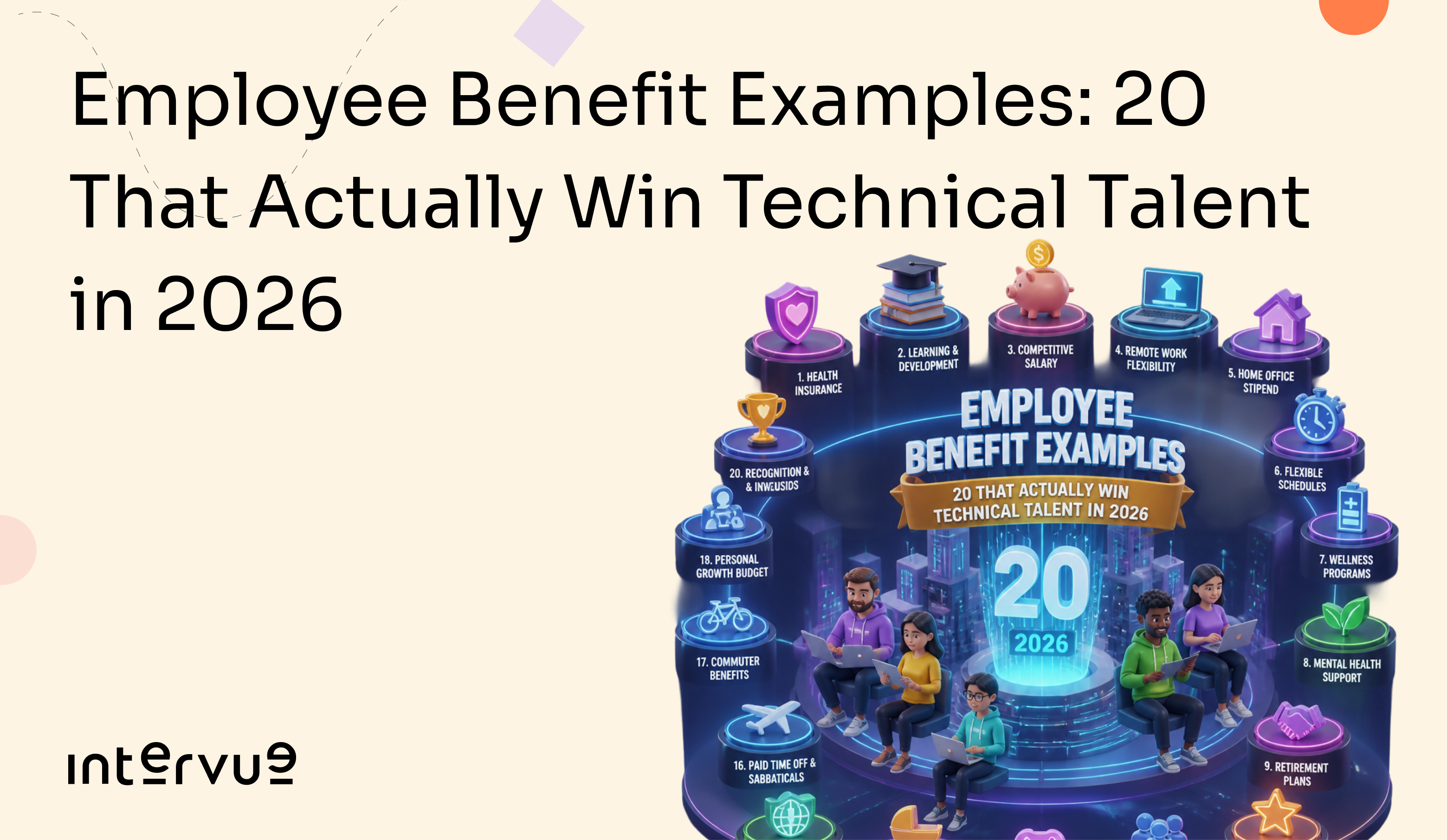
Employee Benefit Examples: 20 That Actually Win Technical Talent in 2026
Most employee benefit examples lists read the same way. Health insurance. PTO. Retirement plan. Eighteen items, equal weight, no context. Then the company publishes its own nearly identical version and wonders why offers are still getting declined.
The problem is not the list. It is the lens. A payroll platform's take on employee benefits optimises for completeness. A hiring platform's take has to optimise for outcomes. We have processed hundreds of thousands of technical interviews across 400+ companies. We see offer-to-join ratios. We hear why engineers decline. That is a different vantage point — and this post is built from it.
If you are putting together or rethinking your employee benefits package for technical roles, here is what actually matters, in order.
The Offer-to-Join Problem Nobody Talks About
Before listing anything, this needs to be said plainly: a benefits package is not just a retention tool. It is an active part of the hiring funnel.
We see companies interview 80 candidates, shortlist 8, extend 7 offers and have 4 accept. That gap is not always salary. It is the full picture of what the company is offering, and how well the company communicates it.
"What matters is your CTC, your culture, the opportunities you offer, how many other companies the candidate has applied to," said Rahul Arora, co-founder of Intervue, describing what he sees in technical hiring loops. Benefits sit inside that evaluation. They are the signal about culture and investment that no interview question can fully substitute for.
And the signal is often wrong. According to the WEF Future of Jobs Report 2025, 64% of employers say employee health and wellbeing is a top talent attraction strategy yet most packages treat health as table stakes and build nothing differentiated on top of it. The companies winning technical hires have figured out that the table stakes are assumed, and the differentiation lives above them. If you want to understand why so many candidates drop off before joining, the benefits package is usually part of the answer.
Table Stakes: Employee Benefit Examples Every Tech Company Must Offer
These are not differentiators. Their absence eliminates you from consideration; their presence does not earn you a yes. Understanding the challenges of technical hiring starts here.
1. Health insurance (medical, dental, vision) Non-negotiable. Engineers with families need family coverage. Dental and vision are increasingly expected alongside medical. Companies offering medical only are already behind.
2. Retirement plan with employer match A 4% match on a $140,000 salary is $5,600 a year. Engineers doing compensation math will notice if your competitor offers it and you do not. The match is effectively part of total compensation.
3. Paid time off - tracked, protected, actually used Unlimited PTO sounds good. In practice it often means engineers take less time off, because there is no clear norm and no social proof that taking time is acceptable. Defined PTO with real culture around using it is more valuable than the headline number.
4. Remote or hybrid work The pandemic ended the debate. Technical work is portable. Requiring full-time in-office without a compelling business reason is losing you candidates to companies that do not require it.
5. Parental leave - above the legal minimum For candidates in their late 20s and 30s, this is increasingly a filtering question. The legal minimum in most US states is not competitive. Companies offering 16+ weeks fully paid for primary caregivers are signalling something meaningful about their values.
6. Life and disability insurance Often bundled with health insurance. Important, expected, not a differentiator — but its absence is a flag.
What Technical Candidates Are Actually Weighing
Here is what most employee benefits lists miss entirely. Technical candidates, especially those with three or more years of experience, are not weighing your health plan against a competitor's. They are weighing your company against another company. The benefits package is one input into a judgment about culture, trajectory, and trust.
The candidate experience during the interview process feeds into the same evaluation. A slow, disorganised interview loop followed by a vague offer letter sends a signal. A fast, structured process followed by a clearly communicated, dollar-quantified benefits package sends a completely different one.
"Candidate drop-off is often not a talent shortage," as one practitioner wrote on r/recruiting. "It is the market giving feedback on a broken process." That feedback often arrives via declined offer letters after the interview process, after the time investment, after the shortlist. Benefits are part of what the market is grading.
Differentiating Employee Benefit Examples for Technical Roles
These are where companies separate themselves. Not all of them are expensive. Some are almost free. All of them are noticed by engineers comparing offers.
7. Learning and development budget dedicated, annual, real Not a vague "we support your growth." A specific dollar amount per engineer per year ($1,500 to $3,000 is common), spent on conferences, certifications, books, or online courses, with a real approval process. The WEF reports that 85% of employers plan to prioritize upskilling in the next five years yet engineers know most L&D programs are barely funded. A real budget is noticed.
8. Home office or equipment stipend For remote roles, a one-time $1,000 to $2,000 equipment budget tells an engineer they are being set up to do their best work. BYOD policies without a stipend send the opposite signal.
9. Mental health support structured, accessible, not performative An EAP nobody knows how to access does not count. Covered therapy sessions with a real network, mental health days that are publicly encouraged by leadership, and a clear no-stigma policy are what engineers are looking for. This benefit has moved from "nice to have" to a filtering criterion for many candidates since 2020.
10. Equity or stock options explained clearly For startups and growth-stage companies, equity is often the decisive differentiator. The key word is "explained." Companies that share the number of shares, current valuation, strike price, vesting schedule, and what an exit might look like build candidate trust. If you are hiring for a startup and wondering how to structure this conversation, the startup founder's guide to hiring for tech roles is worth reading alongside this post.
11. Flexible scheduling async-first cultures No mandatory 9-to-5, protected deep work time, asynchronous communication as the default rather than the exception. Increasingly valued by senior engineers whose most productive hours may not align with a standard workday.
Advanced Employee Perks That Signal Company Quality
12. Conference and speaking budget Sending engineers to domain-specific conferences signals investment in technical community and continued growth. Engineers who stay current stay motivated and stay longer.
13. Internal mobility actively encouraged Only 15% of workers say their employer actively encourages internal mobility (LinkedIn Learning 2025). This is a massive differentiating opportunity precisely because the baseline is so low. Engineers who can move between teams, into technical leadership, or into new problem areas without leaving the company stay longer and grow faster. If you are thinking seriously about how to retain developers, internal mobility is one of the highest-leverage levers available and one of the cheapest.
14. Sabbatical policy Paid four-week sabbaticals after five years. Rare, therefore a strong signal for engineers thinking about a long tenure.
15. Caregiver and childcare support Backup childcare coverage, elder care referral networks, and flexible leave policies for caregiving. As the average engineer ages into their 30s and 40s, this benefit moves from peripheral to central.
16. Student loan repayment Even $100 to $200 per month toward student loan repayment is noticed by engineers carrying six-figure debt. The cost to the company is modest; the signal is disproportionately strong.
17. Financial planning access Access to CFPs, equity planning resources, and tax optimization services. Increasingly offered by companies competing for senior engineers who have complex financial pictures.
Low-Cost Employee Perks With High Signal Value
18. Volunteer time off (VTO) Paid time to volunteer. Engineers who care about impact see this as a proxy for company values.
19. Pet-friendly policy or pet insurance Engineering teams skew toward pet owners. Subsidised pet insurance costs an employer less than $15 per employee per month and generates disproportionate goodwill.
20. Commuter benefits Pre-tax transit and parking benefit. Essentially a tax-free compensation supplement for engineers who come into the office. Small in absolute terms, meaningful in signal.
How to Build an Employee Benefits Package That Works for Technical Hiring
The companies attracting more candidates in competitive technical markets consistently do four things:
First, lock in table stakes before building anything else. No amount of equity and L&D budget compensates for absent or weak health coverage.
Second, ask your engineers what they actually want before adding. The companies that survey their teams and build benefits around real preferences outperform those that guess. You will often find the most valued perks cost less than the ones nobody uses.
Third, communicate the full value in every offer letter. Most companies undersell their benefits package because it never appears in a legible, dollar-quantified form at the point of decision. Break it down. Show the employer retirement match, the L&D budget, the equipment stipend, the equity, the health premium contribution. Make the total visible.
Fourth, track your offer-to-join ratio by benefits tier. If candidates are consistently declining after offers, the package is part of the feedback. Treat it as data, not mystery. And pair this with a faster, higher-quality technical hiring strategy so you are not losing engineers at the finish line after a six-week process.
Frequently Asked Questions
Q: What employee benefit examples matter most for tech companies?
For technical roles, the differentiators above table stakes are a dedicated learning and development budget, equity with clear terms, flexible or async scheduling, mental health support with real access, and above-market retirement contributions. Health insurance is expected — its absence disqualifies; its presence alone does not win.
Q: What should be included in an employee benefits package?
A complete employee benefits package for tech companies includes health, dental, and vision insurance; a 401(k) with employer match above 3%; defined PTO with real culture around taking it; parental leave above the legal minimum; life and disability insurance; and at least two differentiating benefits tied to your company values most commonly an L&D budget and either equity or flexible scheduling.
Q: What are the types of employee benefits companies typically offer?
Benefits generally fall into five categories: insurance (health, dental, vision, life, disability), retirement savings, paid time off, additional compensation (bonuses, commissions, equity), and wellbeing or lifestyle perks (L&D, mental health, flexibility). For tech hiring, the wellbeing and equity categories carry disproportionate weight relative to other industries.
Q: How much does an employee benefits package cost per employee?
Health insurance alone costs employers $6,000 to $20,000 per year per employee depending on family vs individual coverage and contribution level. A full competitive benefits package for a technical employee including health, retirement match, L&D budget, equipment stipend, and equity typically adds 25 to 40% on top of base salary in total value.
Q: What are examples of creative, low-cost employee perks that tech teams value?
The highest-signal low-cost perks for tech teams include: async scheduling policies that protect deep work time, a clearly defined L&D budget even if modest, internal mobility programs that are actively promoted, volunteer time off, and a clearly documented total compensation breakdown so engineers can see what they are actually receiving.
Most companies approach their employee benefits package as a compliance exercise. The ones winning technical hiring treat it as a communication strategy. Your benefits list tells candidates what you believe work should feel like. Engineers are reading it carefully often before they even apply.
We handle the technical interviews. Your engineers handle the product. intervue.io