Most engineers who fail FAANG interviews weren't under-skilled. They were under-prepared, specifically, they prepared without a system.
They solved LeetCode problems without understanding patterns. They read system design articles without ever designing anything end to end. They rehearsed behavioral answers in their heads but never said them out loud to another person.
This guide fixes that. Whether you're a fresher aiming for your first big-tech role or an experienced engineer finally making the leap, here's the complete FAANG interview preparation roadmap for 2026, built around how these interviews actually work, not how people imagine they do.
What Does FAANG Mean in 2026?
FAANG stands for Meta (formerly Facebook), Apple, Amazon, Netflix, and Google. The term is used broadly to describe the top tier of tech companies where competition is highest, compensation is highest, and interview bars are set deliberately hard.
Microsoft is commonly included in this tier. So are companies like Stripe, Uber, and Airbnb for engineering roles, though the acronym itself refers to the original five.
What these companies share: multi-round interview loops, structured evaluation rubrics, and decisions made by hiring committees rather than a single manager. Getting hired is rarely a single person's call, which means one strong round alone won't save you, and one slightly weaker round rarely kills you if the rest is solid.
How Long Should You Prepare for FAANG?
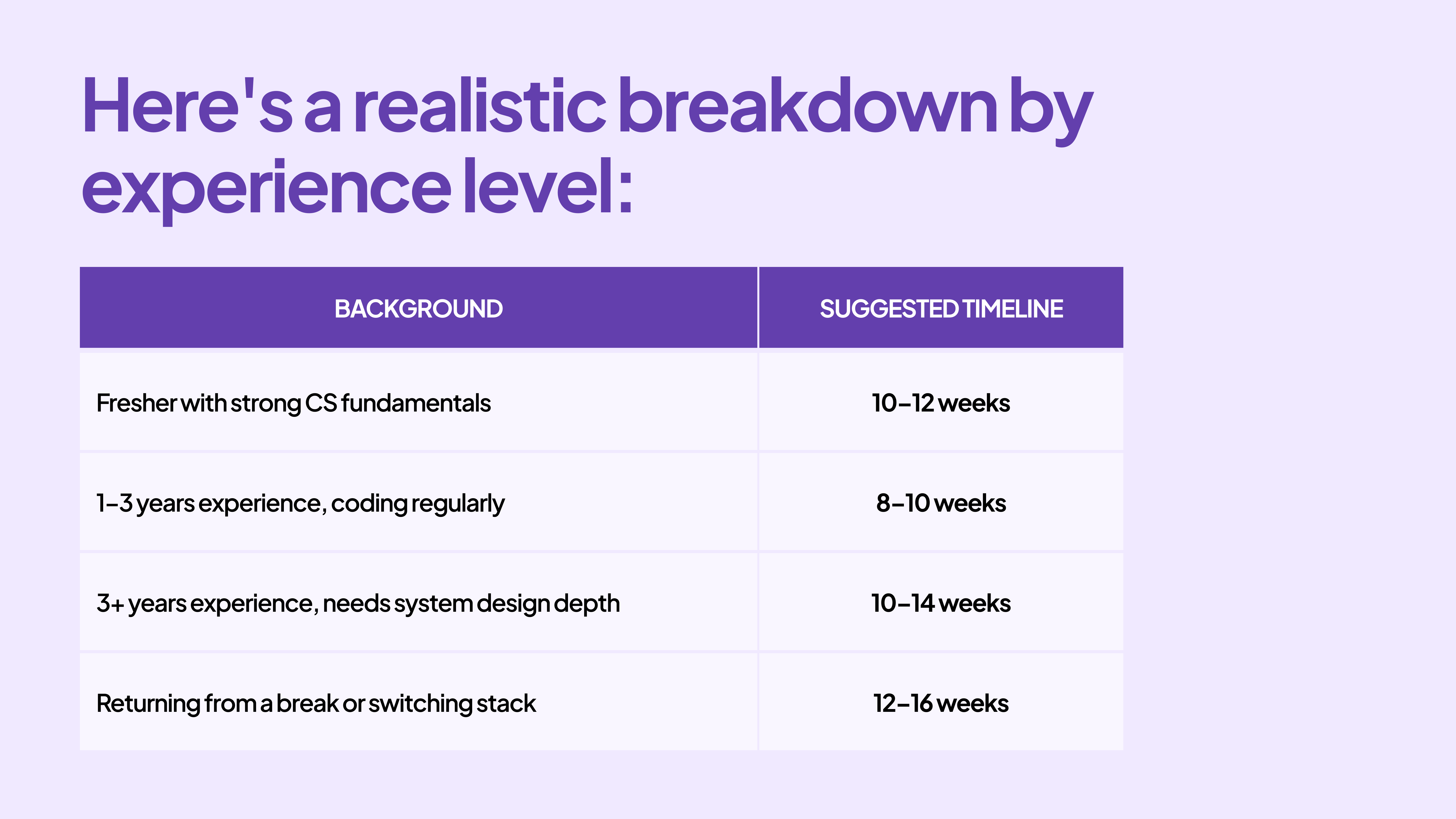
The honest answer: 10 to 14 weeks for most candidates.
Less than that, and you're cutting corners somewhere, usually system design or behavioral, both of which need time to internalise. More than 16 weeks without structured milestones often leads to diminishing returns and decision fatigue.
The goal isn't to prepare longer. It's to prepare with the right structure at each stage.
Phase 1: Data Structures and Algorithms (Weeks 1–6)
Why DSA Still Dominates FAANG Screening
Every FAANG company uses algorithmic coding rounds as a baseline filter, even for senior roles. The reason is practical: it's one of the few interview formats that's hard to fake in real time. You either know how to break down a graph traversal problem or you don't.
What they're not testing: your ability to memorise specific solutions. What they are testing: your ability to recognise problem structure and apply the right approach quickly.
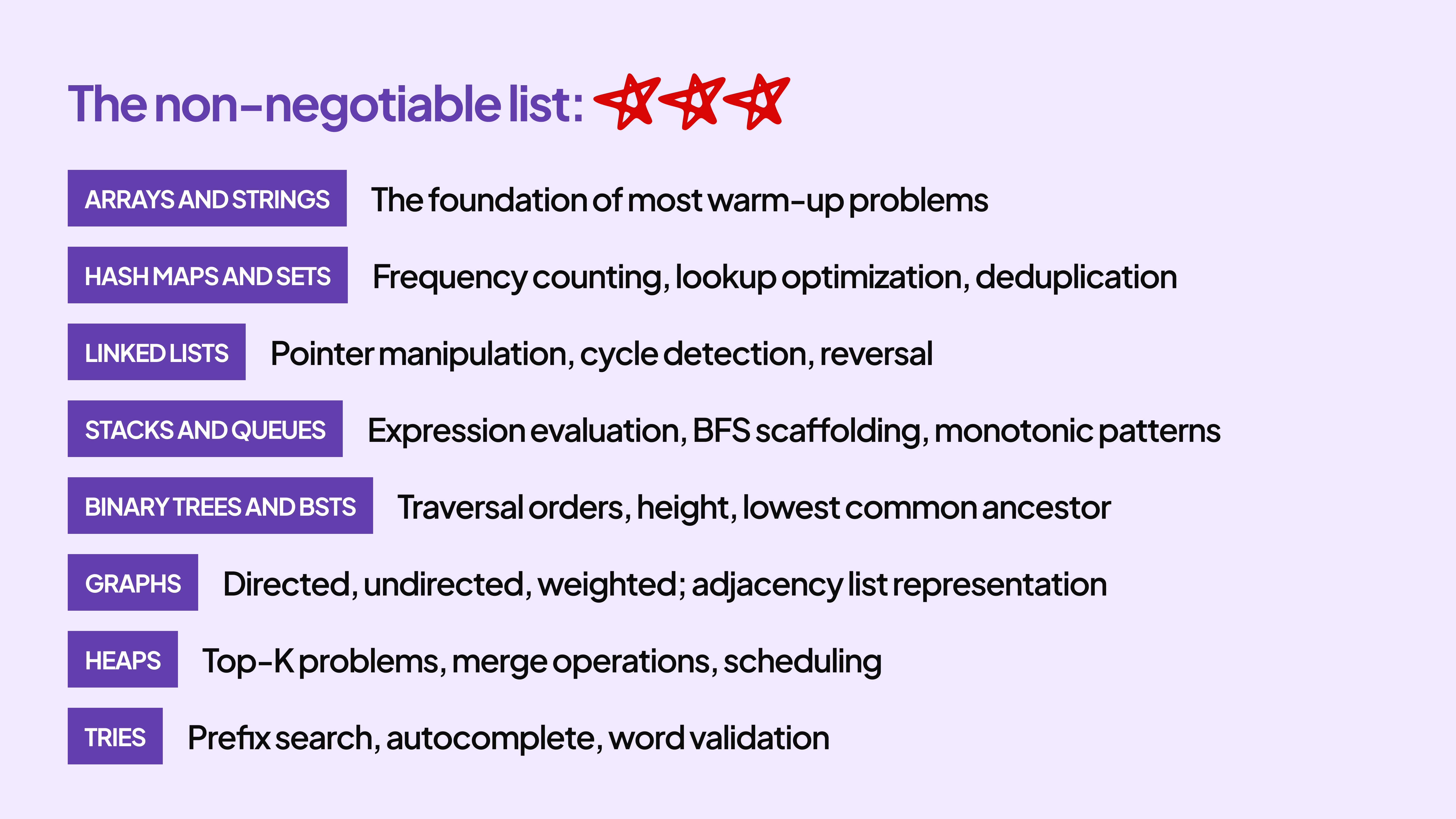
The Data Structures You Must Know Cold
Go beyond surface-level familiarity. For each structure, know how it works internally, what operations cost what in time and space, and what class of problems it solves best.
Learn Patterns, Not Individual Problems
This is the single biggest lever in DSA preparation. When you learn a pattern, you can solve problems you've never encountered before because you recognise the underlying shape of the question.
The 8 patterns that unlock the majority of FAANG coding questions:
1. Two Pointers: Used when you need to find a pair, remove duplicates, or compare from both ends of a sorted structure. Eliminates the need for nested loops.
2. Sliding Window: Used for subarray or substring problems where you need to find an optimal contiguous range. The window expands and contracts based on a condition.
3. Binary Search on Answer Space: Goes beyond sorted array search. If a problem asks for a minimum or maximum value that satisfies some condition, binary search often applies to the answer range itself.
4. BFS and DFS: Breadth-first for shortest paths and level-by-level tree problems. Depth-first for exhaustive exploration, connected components, and path tracking.
5. Recursion and Backtracking: Used for permutation, combination, and constraint-satisfaction problems. The key is knowing when to prune, stopping recursion early when a path can't lead to a valid solution.
6. Dynamic Programming: Breaks problems into overlapping subproblems and stores intermediate results. Master both top-down (memoisation) and bottom-up (tabulation) approaches.
7. Greedy Algorithms: Make the locally optimal choice at each step. Works when the problem has an "optimal substructure", interval scheduling, activity selection, coin change under certain conditions.
8. Topological Sort: For problems with dependencies, course prerequisites, task ordering, build systems. Only applies to directed acyclic graphs.
How to Practice Effectively
Structure your practice around patterns, not volume:
- Spend 2–3 days per pattern
- Solve 8–12 problems per pattern at increasing difficulty
- After solving, explain your solution out loud as if an interviewer is listening
- When you're stuck, don't immediately look at the answer, sit with the problem for 25 minutes first
The talking-out-loud part is not optional. It's the skill the interview actually tests, and most candidates never practice it until they're in the room.
Phase 2: System Design Interview Preparation (Weeks 7–9)
What System Design Rounds Are Really Evaluating
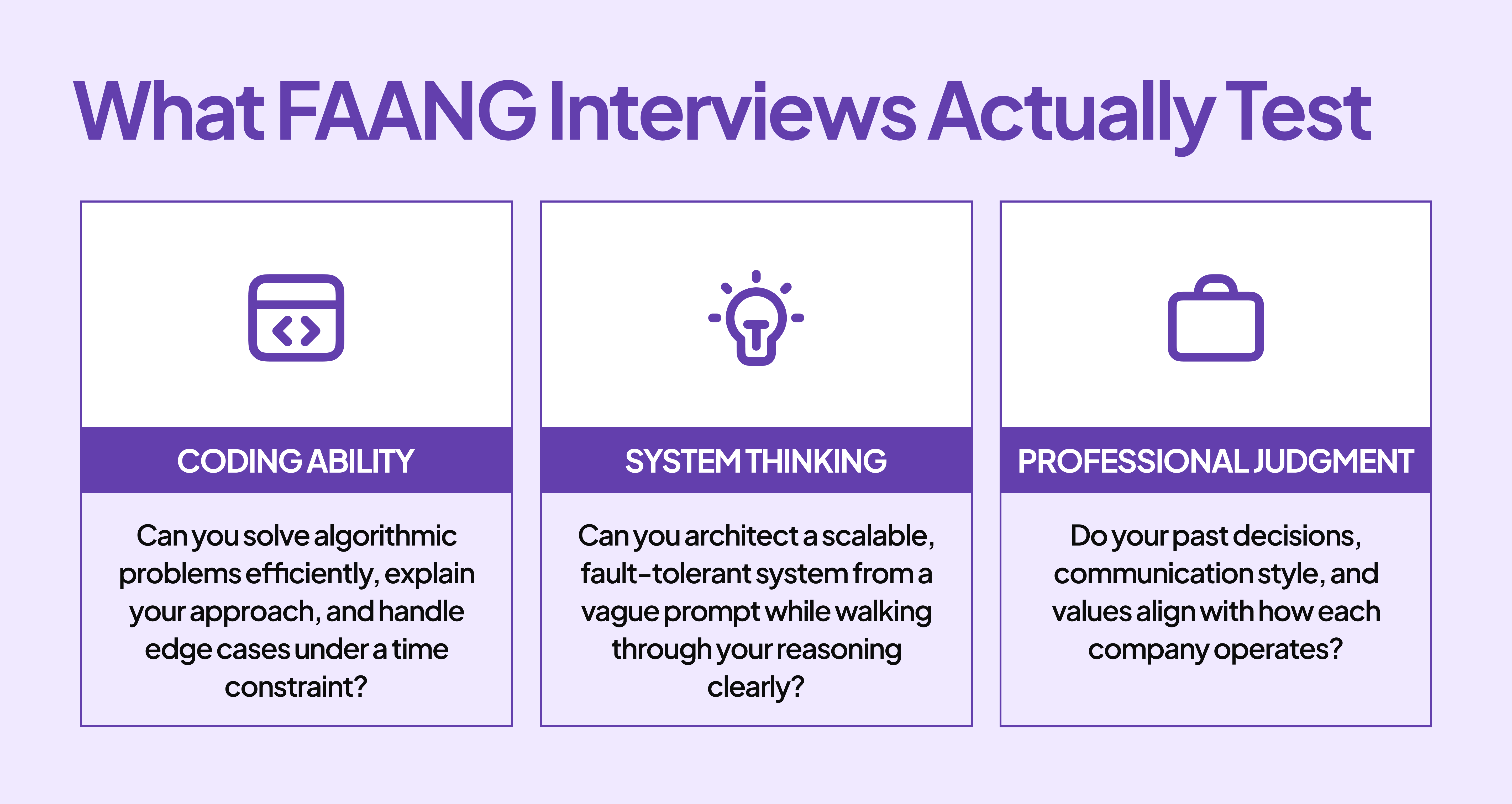
System design interviews feel open-ended because they are. There's no single correct answer to "design a notification service." What the interviewer is evaluating is your engineering judgment, how you scope the problem, what tradeoffs you surface, and how clearly you communicate decisions.
They want to see that you've built and thought about systems at scale, not just written code that works on your laptop.
Foundational Concepts to Understand Before Practicing
Do not jump straight into practice problems without building this foundation:
- Scalability basics - horizontal vs. vertical scaling, stateless vs. stateful services
- Load balancing - round robin, least connections, consistent hashing
- Databases - SQL vs. NoSQL tradeoffs, indexing, normalisation, replication
- Caching - where to cache (client, CDN, application, database), eviction policies, cache invalidation
- Async processing - message queues, event-driven architecture, eventual consistency
- CAP theorem - understanding why you can't have consistency, availability, and partition tolerance simultaneously
- API design - REST vs. gRPC, pagination, rate limiting, versioning
- Data partitioning - sharding strategies, hotspot prevention
System Design Problems to Practice End-to-End
Practice these by designing them fully, not just reading about them:
- URL shortener (simple but reveals a lot about database choice and hashing)
- Social media feed (write-heavy vs. read-heavy tradeoffs, fan-out)
- Chat application (WebSockets, message storage, delivery guarantees)
- Ride-sharing backend (geolocation, matching algorithms, real-time updates)
- Video streaming platform (CDN, transcoding, adaptive bitrate)
- Distributed rate limiter (token bucket, sliding window counter)
- Search autocomplete (trie vs. database, ranking, latency constraints)
How to Structure a System Design Answer
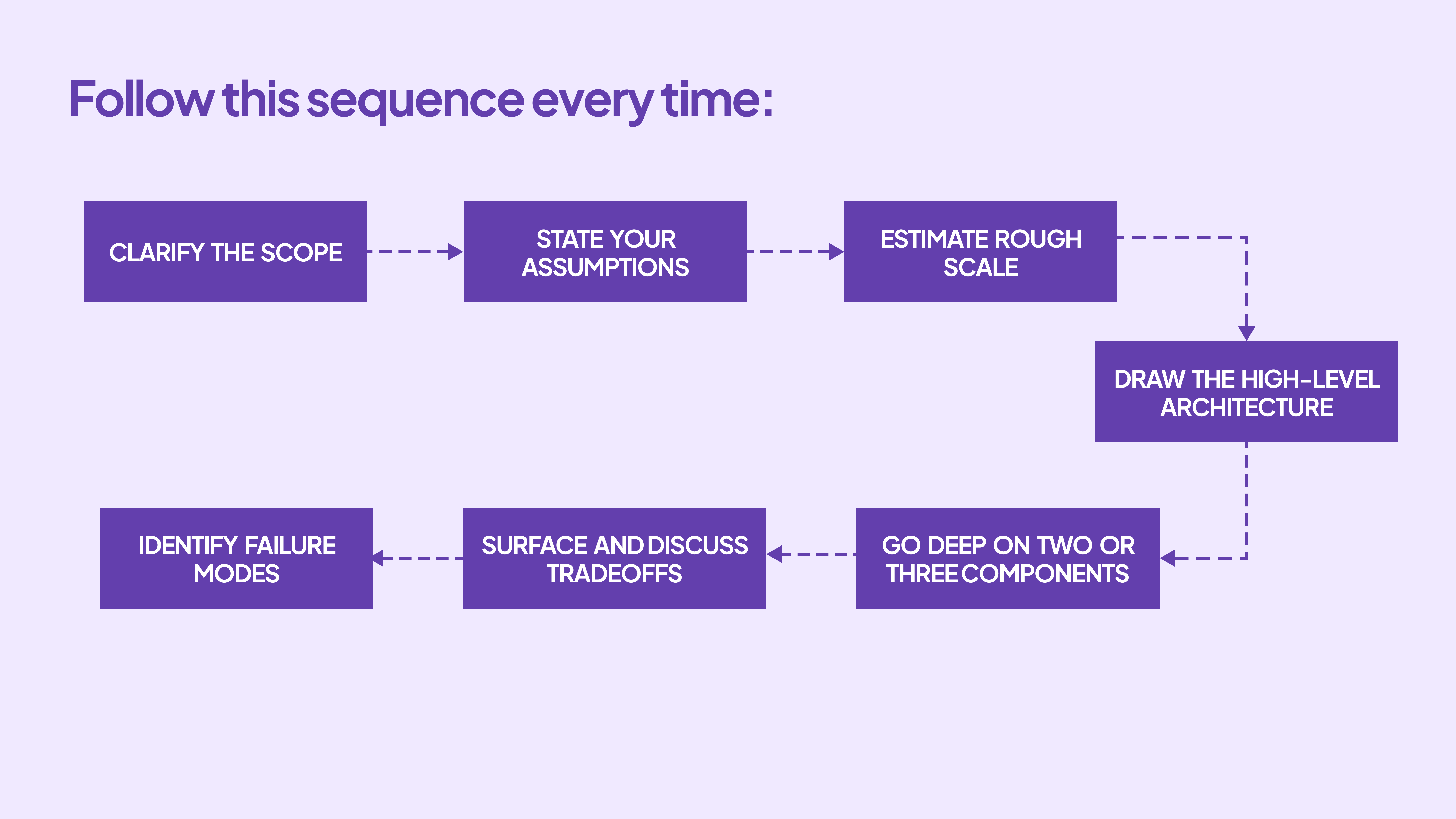
The worst thing you can do in a system design round is rush to a final design without scoping. Interviewers penalise candidates who jump to solutions before understanding the problem.
Phase 3: Behavioral Interview Preparation (Weeks 10–11)
Why Behavioral Rounds Carry More Weight Than Most Candidates Realise
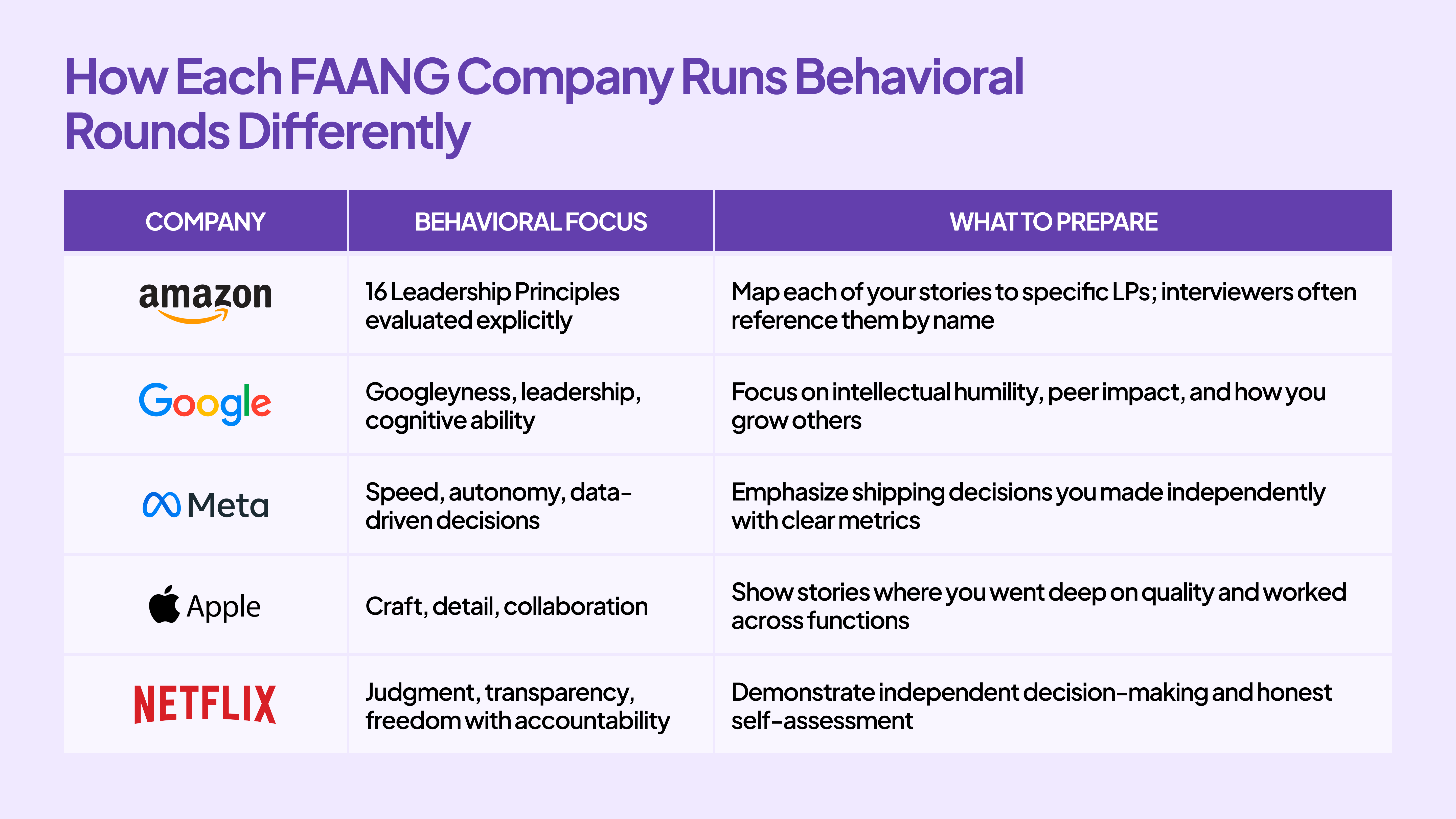
At every major FAANG company, offer decisions go through a hiring committee, not just the interviewers in your loop. That committee reads all feedback, including behavioral signals.
Technical strength gets you to the table. Behavioral signals determine whether you actually get the offer.
A candidate who codes cleanly but can't articulate their impact, handle conflict constructively, or demonstrate ownership is a risk at scale. FAANG companies don't just hire for skill, they hire for how you'll operate when things get hard.
The STAR Framework, and How Most Candidates Use It Wrong
STAR (Situation, Task, Action, Result) is the right structure. The common mistake is spending too much time on context and not enough on what you specifically did and what changed because of it.
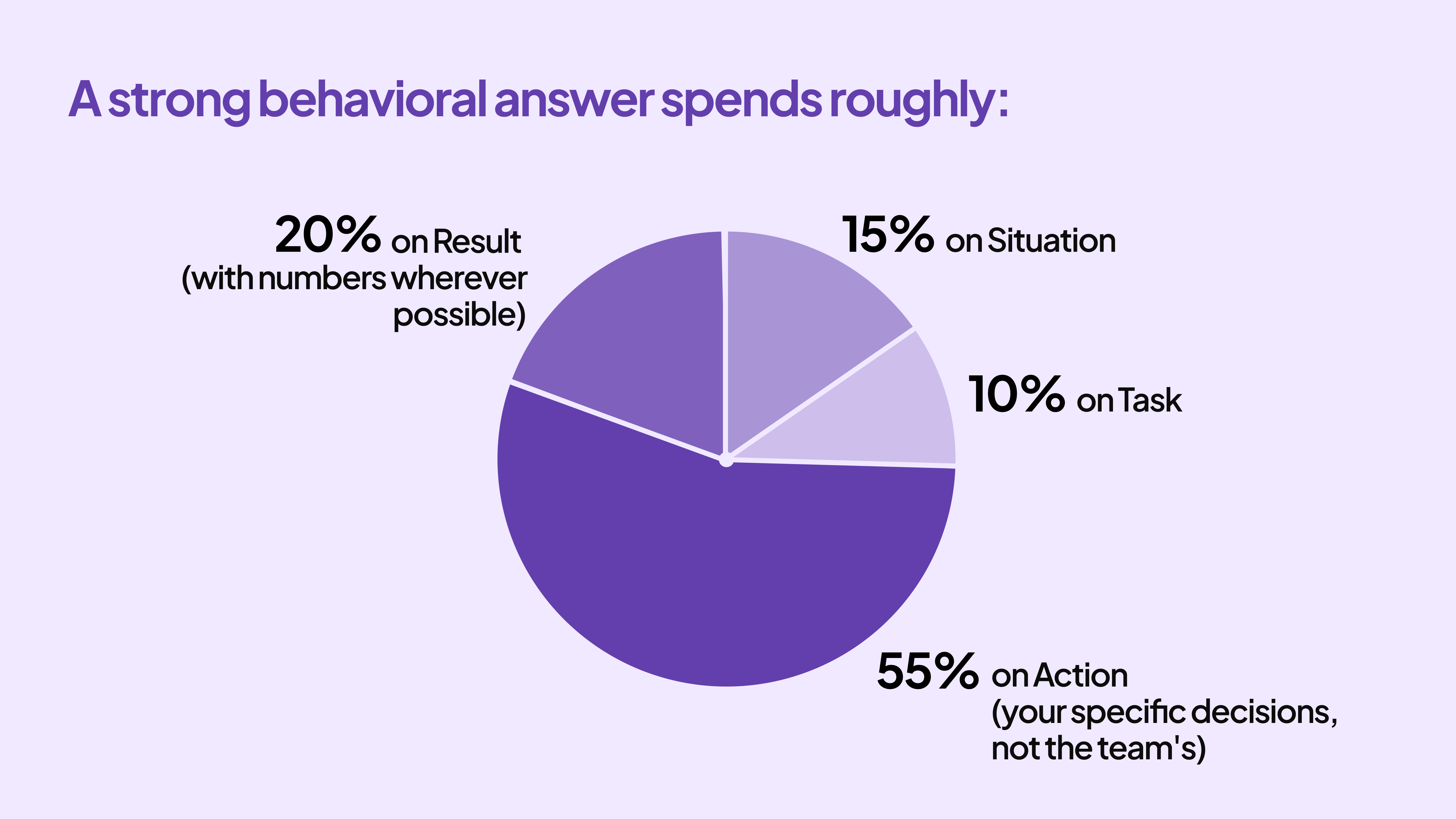
When you say "we did X," an interviewer hears that you might not have been the one who did it. Use "I" intentionally.
Build a Story Bank of 10 Core Experiences
Prepare and rehearse answers for these categories before your interview:
- A technically complex problem you solved from first principles
- A time you made a call with incomplete information
- A project you drove from ambiguous brief to shipped outcome
- A disagreement with a manager or peer, and how you handled it
- A time you failed and what you did differently afterward
- A situation where you improved a process without being asked
- A time you had to say no to a stakeholder or a feature request
- A moment where you had to learn something fast under pressure
- Your most impactful contribution in your current or last role
- A time you had to balance quality with speed
Each story should be STAR-formatted, under 3 minutes when spoken aloud, and backed by a specific outcome.
The FAANG Interview Loop, What to Expect at Each Stage
Stage 1: Online Assessment or Recruiter Screen
An initial filter, usually 60–90 minutes. Expect 2–3 coding problems of easy-to-medium difficulty. The bar here is lower than the onsite, the goal is to confirm you can code at all.
Stage 2: Technical Phone Screen
One interviewer, one coding problem, 45–60 minutes. This is where candidates get eliminated for poor communication more than poor coding. You're expected to talk through your approach before writing a single line.
Stage 3: The Onsite Loop (Virtual or In-Person)
Typically 4–6 rounds in a single day:
- 2–3 coding rounds
- 1 system design round (mid-level and above)
- 1–2 behavioral rounds
- Occasionally a domain-specific or role-specific round
Each round is scored independently. The hiring committee looks for consistency of signal across rounds, not perfection in any single one.
Stage 4: Hiring Committee Review
Your interview scorecards go to a committee that calibrates against the bar for that level. A "strong hire" from every interviewer still goes through this process. This is where your behavioral performance, across all rounds, not just the behavioral round, is weighed heavily.
One Practice Habit That Separates Candidates Who Pass From Those Who Don't
Most candidates prepare alone. They solve problems silently, read system design posts without designing anything, and rehearse behavioral stories in their head.
Then they walk into an interview and discover that talking while thinking, explaining your reasoning, handling an interviewer's redirection, defending your design choice, is a completely different skill from solving problems in silence.
The fix is deliberate practice under real conditions, with another person, before your actual loop.
Candidates who do 5 or more timed mock interviews before their FAANG loop are significantly more likely to pass than those who don't, not because they know more, but because they've already experienced the discomfort of performing under pressure and learned to manage it.
At Intervue.io, mock interviews are conducted by engineers who've been on real hiring loops, not AI simulators. You get structured, round-specific feedback that tells you exactly what to fix before the interview that matters.
Summary
FAANG interviews are hard to crack not because the bar is unreachable, but because most candidates prepare the wrong way.
The formula that works:
- Learn DSA through patterns, not problem count
- Practice talking out loud while solving, from day one
- Build system design understanding through actual design practice, not just reading
- Prepare behavioral stories that are company-specific, STAR-structured, and outcome-backed
- Run at least 5 mock interviews with real feedback before your loop
The gap between candidates who receive offers and those who don't usually isn't raw ability. It's structured preparation and pressure-tested practice.
When you're ready to experience what a real interview loop actually feels like, with feedback that helps you fix what's costing you the offer, try a mock interview on Intervue.io.